How long do water heaters last?
A typical tank water heater lasts about 10 years, give or take a few. Here's what the published estimates say, what wears a heater out early, and how to tell where yours stands.
Updated October 21, 2026 · 6 min read · By the Heater Doctor team
Short answer
Most tank water heaters last about 6 to 13 years. InterNACHI puts conventional tanks at 6 to 12 years and calls 10 years typical. A U.S. Department of Energy study used 13 years for tanks and 20 years for tankless units. Hard water, skipped maintenance and heavy use push a heater toward the short end.
What the published numbers say
Estimates vary a little depending on who's counting:
- Conventional tank heaters: 6 to 12 years on InterNACHI's life expectancy chart, with about 10 years described as typical.
- Tank heaters in DOE research: a Department of Energy Building America study used an estimated life of 13 years.
- Tankless heaters: the same DOE study used 20 years. InterNACHI's chart lists on-demand heaters at about 10 years, so treat 20 as a best case that depends on regular descaling.
No chart can tell you exactly when your heater will fail. They tell you when to start paying attention.
Find your heater's age
The label on the side of the tank lists the model and serial number. Some labels print the manufacture date. If yours doesn't, the serial number usually encodes the month and year, and each brand uses its own format. A photo of the label lets a plumber read it for you.
If the heater came with the house, the build year is a rough guide. A home built 12 years ago that still has its original tank is living on borrowed time.
What shortens a water heater's life
InterNACHI lists several factors that decide where in that range a heater lands:
- Hard water. Minerals settle as sediment and scale, and heaters in hard-water areas have shorter lives. Kuna, Idaho, for example, rates its city water as hard at about 8 grains per gallon (see our Kuna page).
- Corrosive water. Some water dissolves metal. Norwell, Massachusetts treats its naturally corrosive groundwater to raise the pH before it reaches homes (see our Norwell page).
- The anode rod. This metal rod corrodes so the steel tank doesn't. Once it's used up, the tank itself starts to rust. Bigger or thicker anodes protect longer.
- Heavy use. More hot water means more heating cycles and more wear.
- Build quality. Cheaper models generally don't last as long. A longer warranty is a decent hint at a sturdier tank.
- Installation. InterNACHI says heaters should be installed upright in well-ventilated areas, and that poor ventilation can shorten a heater's life.
How to help it last longer
A. O. Smith recommends checking the temperature and pressure relief valve once a year and inspecting the anode rod, which is replaced when it's worn. A DOE and Oak Ridge National Laboratory remodeling guide suggests checking the anode every three to five years in normal water, and clearing sediment from the bottom of the tank.
Flushing a few gallons out of the drain valve once a year helps keep sediment from building up. If an older tank has never been flushed, ask a plumber first. Loosened sediment can clog the drain valve so it won't close.
Signs it's near the end
- Rusty or discolored hot water, especially if the cold water is clear
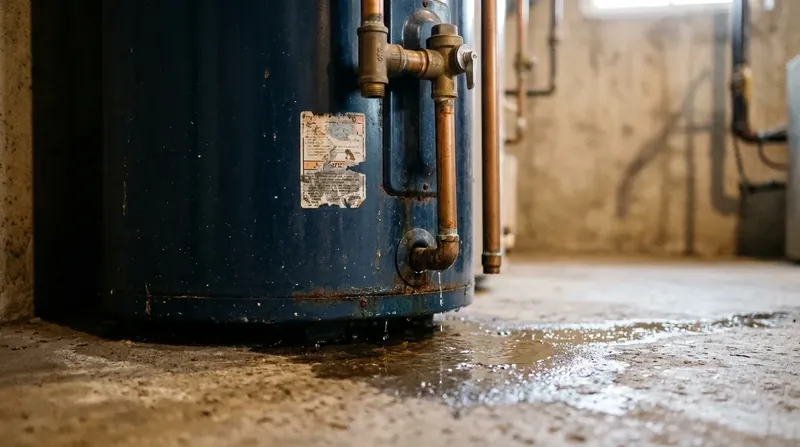
- Water pooling around the base, or a damp ring under the tank
- Popping or rumbling that keeps getting louder
- Hot water that runs out much faster than it used to
- Repairs that keep coming back
A leak from the tank body itself can't be repaired, and the heater has to be replaced. A failed part on a sound tank, like a thermocouple, element or thermostat, usually can be.
Rather have a plumber look at it?
Call and describe what's happening. We'll get a plumber out to diagnose and fix it.
Call for service(858) 465-8561Local pages mentioned
Related water heater services
Water Heater Repair
Gas, electric and tankless repairs, from pilot lights to heating elements.
Learn moreLeaking Water Heater
Water around the tank or a dripping relief valve. Act before it floods.
Learn more
Water Heater Replacement
When repair no longer makes sense, get a new tank or tankless unit.
Learn moreCommon questions
Can a water heater last 20 years?
Some do, especially tankless units that are descaled regularly and tanks in soft water whose anode rods were replaced. It's the exception for tanks, not the rule.
Should I replace my water heater at 10 years even if it works?
Not automatically. Have it checked. If the anode is gone, the water is rusty or the tank is weeping, plan a replacement. If it's clean and dry, many keep going for a few more years.
Do electric water heaters last longer than gas?
Published charts like InterNACHI's give the same range for conventional tanks of either fuel. Water quality and maintenance matter more than the fuel.
Sources
- InterNACHI, Estimating the Lifespan of a Water Heater
- InterNACHI, Standard Estimated Life Expectancy Chart for Homes
- U.S. DOE Building America, Assessing the Energy Savings of Tankless Water Heaters (2012)
- U.S. DOE / ORNL, No-Regrets Remodeling
- A. O. Smith, Water Heater Maintenance Guide
- City of Kuna, water reports
- Norwell Water Department, 2025 water quality report
General information only. Gas, electrical and pressure work can be dangerous; when in doubt, call a licensed professional.
Still stuck? Get a plumber out.
Call now for water heater repair or replacement.