Point-of-use water heaters: what they do and when they're worth it
A bathroom at the far end of the house that takes forever to run hot. A garage sink or a new addition with no hot line. That's where small point-of-use water heaters come in. They aren't a replacement for a main water heater in most homes, but in the right spot they save waiting, water and energy. Here's how the two types work and what to check before buying one.
Updated October 29, 2026 · 7 min read · By the Heater Doctor team
Short answer
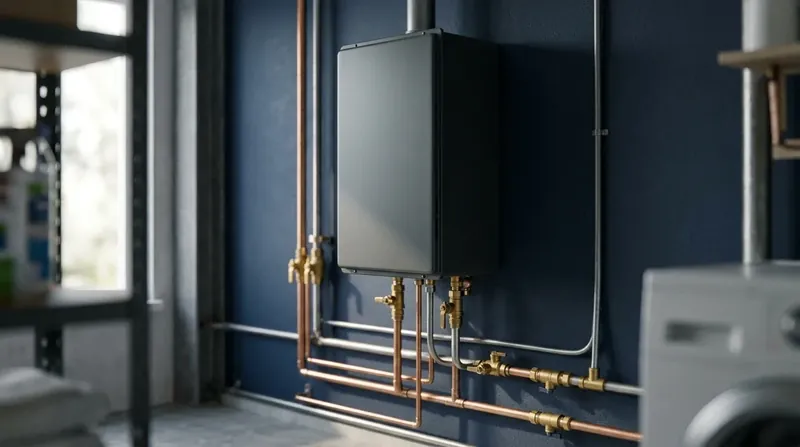
A point-of-use (POU) water heater is a small unit installed at or near one fixture, usually under a sink, instead of relying on a central heater far away. There are two types: electric mini-tanks, which store a few gallons (Rheem sells 1.5 to 6 gallons, some plugging into a 120V outlet), and electric tankless units, which heat water as it flows but can need a 240V circuit of 30 to 50 amps. ENERGY STAR says POUs suit fixtures far from the main heater, low hot water use and additions. A. O. Smith says mini-tanks are designed for one low-flow shower or one or two sinks.
What point of use means
ENERGY STAR explains that the term is used because water is heated very near the sink, shower or bath where it's used, instead of at a central heater. Some heat is always lost in the pipes between a central water heater and a faucet; heating water at the fixture cuts that loss, and ENERGY STAR says POUs are often used to boost the temperature at a fixture that is a long way from the central heater.
Mini-tank vs tankless point-of-use
| Electric mini-tank | Electric tankless (POU) | |
|---|---|---|
| How it works | Keeps a few gallons hot, ready to use | Heats water only while it flows |
| Size | Rheem: 1.5, 2.5, 4 and 6 gallons; A. O. Smith: about 3 to 7 gallons nominal | Wall-mounted box; Stiebel Eltron's DHC-E holds 0.13 gallon |
| Power | Some Rheem models plug into a grounded 120V outlet, with no electrical work | Stiebel Eltron DHC-E: 240V, 30/40 A (7.2/9.6 kW) or 50 A (12 kW) |
| Limit | Runs out in heavy use, then reheats, per A. O. Smith | Doesn't run out, but the temperature rise falls as flow goes up |
A. O. Smith describes both: mini-tanks preheat reserved water and can run out during high demand; tankless units heat water as it passes through, giving a continuous flow.
Can a point-of-use heater run a shower?
Sometimes, with the right unit. A. O. Smith says its mini-tanks are designed for single-use applications such as a single low-flow shower or one or two sinks, and that a shower needs more than a single faucet. For tankless POUs, the specification sheet tells you. Stiebel Eltron's DHC-E 12, at 240V, raises water temperature by about 54°F at 1.5 gallons per minute and about 36°F at 2.25 gallons per minute. That rise is added to the temperature your cold water arrives at, so the colder your incoming water, the lower the flow you can heat to shower temperature. A whole bathroom or several fixtures at once usually call for a full-size heater (see tank vs tankless water heaters and what size water heater you need).
When a point-of-use heater makes sense
ENERGY STAR lists these as more likely to save energy and money with a decentralized setup:
- fixtures far from the other fixtures and from the main heater;
- low daily hot water use, for example less than 20 gallons a day;
- remote bathrooms or hot tubs;
- additions, where it suggests a POU heater and only cold water plumbing to the new space.
ENERGY STAR also says adding a POU at a distant fixture may be the best option for system-wide efficiency, compared with turning up the main tank's thermostat to compensate. A. O. Smith adds that most mini-tank installs are in small homes, apartments, garages and mobile homes, or wherever a fixture is far from the main heater.
When it doesn't
- As the home's only heater in a typical family house. A. O. Smith says mini-tanks aren't equipped for large demands.
- As a backup for solar or geothermal water heating. ENERGY STAR says POUs are not suitable backups because they can't carry a household's full hot water demand when those systems aren't running.
- Without the electrical capacity. A tankless POU drawing 40 or 50 amps at 240V needs a circuit sized for it. Stiebel Eltron's sheet lists minimum breaker and wire sizes, and says to check local codes.
If the main heater simply runs out too fast, the fix may be the heater itself (see hot water runs out fast).
Installation basics
A. O. Smith says a mini-tank connects directly to a cold water supply: cold water fills the tank, an electric element heats it to the set temperature, and opening the faucet releases it. Sizing depends on the fixture's flow rate. ENERGY STAR says costs and benefits should be weighed carefully before going decentralized. Have a licensed electrician handle any new 240V circuit, and check whether your area requires a permit (see do you need a permit).
Running costs
A point-of-use heater doesn't change electricity prices, but it can cut the hot water lost in long pipe runs, which ENERGY STAR identifies as wasted heat. What a fixture costs to heat still depends on how much hot water it uses and your rate. For how water heating costs compare by fuel and state, see cost to run a water heater.
Rather have a plumber look at it?
Call and describe what's happening. We'll get a plumber out to diagnose and fix it.
Call for service(858) 465-8561Related water heater services
Water Heater Repair
Gas, electric and tankless repairs, from pilot lights to heating elements.
Learn more
Water Heater Replacement
When repair no longer makes sense, get a new tank or tankless unit.
Learn moreTankless Water Heater Repair
Error codes, lukewarm water and scale buildup on tankless units.
Learn moreCommon questions
Are point-of-use water heaters any good?
For the right job, yes. ENERGY STAR says they suit fixtures far from the main heater, low daily hot water use (under about 20 gallons a day), additions and hot tubs. They aren't meant to replace a main heater in a typical home.
Can I use a point-of-use water heater for a shower?
Some can. A. O. Smith says its mini-tanks can serve a single low-flow shower. Tankless POUs depend on flow: Stiebel Eltron's DHC-E 12 raises water about 54°F at 1.5 gallons per minute.
Do point-of-use water heaters need a special outlet?
Some mini-tanks plug into a standard grounded 120V outlet, per Rheem. Electric tankless POUs such as Stiebel Eltron's DHC-E run on 240V or 208V, with 30 to 50 amp breakers recommended.
What size point-of-use water heater do I need?
A. O. Smith says it depends on the fixture's flow rate; its mini-tanks range from about 3 to 7 gallons, and a shower needs more than a single faucet.
Does a point-of-use heater save energy?
It can. ENERGY STAR says heating water at the fixture reduces heat lost in the pipes and may be more efficient than raising the main tank's temperature for a distant fixture.
Sources
- ENERGY STAR, Point of Use (POU) Water Heaters
- A. O. Smith, Point-of-Use Electric Mini-Tank Water Heaters
- Rheem, Point-of-Use Water Heaters
- Stiebel Eltron, DHC-E Technical Specifications (PDF)
General information only. Gas, electrical and pressure work can be dangerous; when in doubt, call a licensed professional.
Still stuck? Get a plumber out.
Call now for water heater repair or replacement.