Tankless water heater not heating: causes and what to check
A tankless water heater only fires when it senses enough water moving through it, and only stays lit with enough gas and a clear vent. Most no-heat calls trace back to one of those.
Updated October 26, 2026 · 6 min read · By the Heater Doctor team
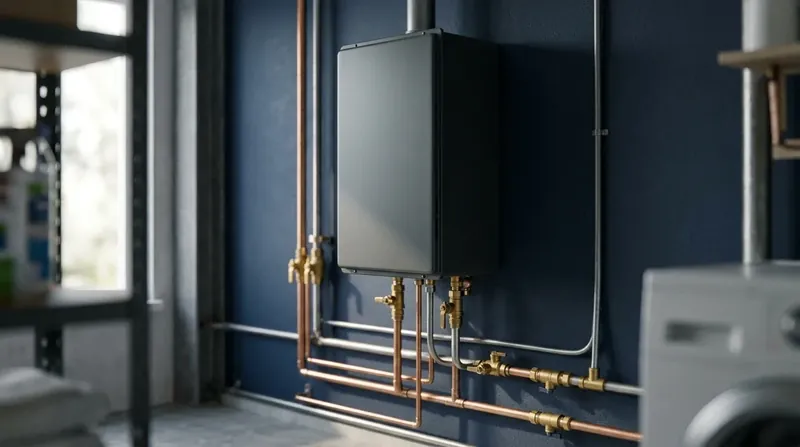
Short answer
Start with the basics Noritz lists: make sure the gas valve is fully open, the unit has power and the breaker hasn't tripped, the water valves are open, and note any error code on the display. If it heats at the shower but not a low-flow faucet, the flow may be below what it needs to fire; Rinnai says its units need about 0.4 to 0.6 gallons per minute to ignite. Lukewarm water that swings hot and cold usually points to scale, a clogged inlet filter or too many fixtures at once.
No hot water at all
Noritz's troubleshooting guide lists gas supply interruptions, power problems, ignition failure, closed water valves and system errors as the usual causes. Its checks, in order:
- Gas supply valve fully open. On propane, Rinnai adds, make sure the tank actually has gas.
- Power on and breaker not tripped. A tankless gas unit still needs electricity for its controls, fan and igniter.
- Water supply valves open.
- Read the error code, then reset as the manufacturer directs. If the code comes back, call a technician.
On Rinnai units, code 11 is an ignition failure and code 12 means the flame went out. Rinnai's diagnostic manual starts both with the gas: valves open, propane in the tank, air purged from new gas lines, the right gas type and enough inlet pressure. It notes that a loose flame rod or electrode can also cause either code.
Hot at the shower, cold at the sink
A tankless heater uses a flow sensor to decide when to fire. Rinnai says its tankless gas water heaters need at least 0.4 to 0.6 gallons per minute through the hot side to ignite, and about 0.26 gallons per minute to stay on. A trickle from a bathroom faucet, or a low-flow aerator, may never reach that. Open the tap further and see if it lights.
When there's no error code at all, Rinnai's manual lists more flow-side causes: a clogged inlet water filter, hot and cold lines reversed, a crossover somewhere in the plumbing or a fixture that lets cold water into the hot line, or a flow sensor turbine that doesn't spin freely.
Lukewarm, or hot then cold
Noritz lists mineral scale, restricted flow, the temperature setting and several fixtures running at once as causes of water that swings between hot and cold. Its fixes: check the set temperature, clean or replace clogged water filters, descale the heat exchanger if maintenance is overdue, and try one fixture at a time to see whether you're asking for more hot water than the unit can make.
Scale is the big one in hard water areas. Rinnai's units display LC (or LC0 to LC9) when scale is building up in the heat exchanger, and it's the only code that lets the heater keep running. The fix is flushing the heat exchanger, and Rinnai says hard water must be treated to prevent it coming back. Coeur d'Alene, Idaho averaged 8.25 grains per gallon in its 2025 water report, which it rates as hard (see our Coeur d'Alene page), and Nampa reports up to 7.08 grains per gallon (see our Nampa page).
Not enough gas
Rinnai's manual says that if the inlet gas pressure is below what the rating plate lists, the gas system may be undersized. On natural gas it allows no more than a 0.3-inch water column drop with every gas appliance in the building at high fire, and 0.5 inch on propane. The problem can be the pipe size, the regulator, the meter, the propane tank or debris in the line. If the water only goes lukewarm while other gas appliances are running, the supply is the first thing to check.
Shuts off mid-shower
Noritz says unexpected shutdowns usually come from safety systems: a blocked vent, overheating protection, gas supply problems or dirty combustion parts. Its checks: look for obstructions at the vent termination, make sure there's airflow around the unit and inspect the gas connections. Rinnai's troubleshooting steps for airflow faults add checking the fan and looking for blockage in the heat exchanger.
When to call
Gas pressure tests, flame rods, igniters and flow sensors are jobs for a technician. Rinnai's own manual warns you must be qualified to service gas systems before going further. Our tankless water heater repair page covers what we see most. If scale is the cause, see tank vs tankless for how upkeep differs.
Rather have a plumber look at it?
Call and describe what's happening. We'll get a plumber out to diagnose and fix it.
Call for service(858) 465-8561Local pages mentioned
Related water heater services
Common questions
Why is my tankless water heater not getting hot?
Check that the gas valve is open, the unit has power and the water valves are open. Low flow, scale in the heat exchanger, a clogged inlet filter or an undersized gas line are the next suspects.
What is the minimum flow for a tankless water heater to turn on?
Rinnai says its gas tankless units need about 0.4 to 0.6 gallons per minute to ignite and 0.26 gallons per minute to keep running.
What does LC mean on a Rinnai tankless water heater?
Rinnai uses LC and LC0 to LC9 to warn of scale buildup in the heat exchanger. The unit needs flushing, and hard water should be treated.
Sources
- Noritz, Tankless Water Heater Troubleshooting Guide
- Rinnai, Residential FAQs
- Rinnai, Troubleshooting Tankless Water Heater Diagnostic Codes
General information only. Gas, electrical and pressure work can be dangerous; when in doubt, call a licensed professional.
Still stuck? Get a plumber out.
Call now for water heater repair or replacement.