Do you need a water heater expansion tank?
Heating water makes it expand, and in most modern homes that extra volume has nowhere to go. An expansion tank gives it somewhere. Here's how to tell whether you need one.
Updated October 21, 2026 · 6 min read · By the Heater Doctor team
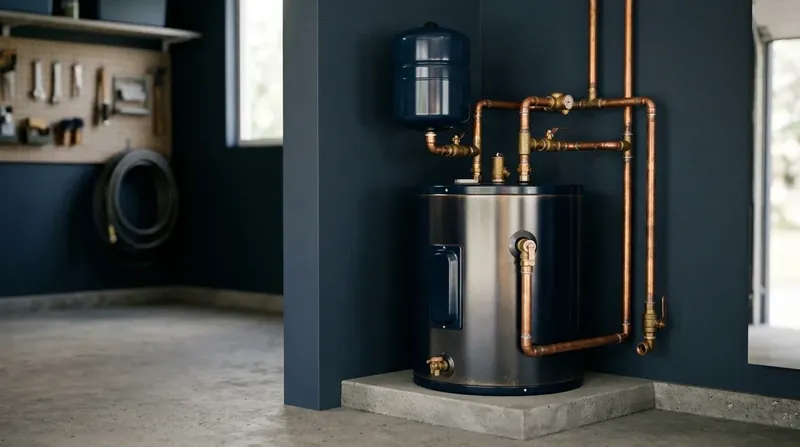
Short answer
You likely need an expansion tank if your plumbing is a closed system, meaning the water comes in through a check valve, pressure-reducing valve or backflow preventer. The International Plumbing Code requires thermal expansion control in that case. A dripping relief valve, or pressure that climbs while the heater runs, are the telltale signs.
Why water heaters need room to expand
A. O. Smith explains it simply: water expands when heated, but it can't be compressed. In older homes, the extra volume pushed back into the city main. Most systems today are closed to protect the public water supply, so the pressure builds inside your pipes instead. A. O. Smith says a home at a normal 60 psi can see pressure climb to 120 psi or higher during a heating cycle.
That's hard on the heater and the plumbing. A. O. Smith calls high water pressure one of the main reasons water heaters leak early.
What the plumbing code says
Section 607.3 of the International Plumbing Code says that where a storage water heater is supplied with cold water that passes through a check valve, pressure-reducing valve or backflow preventer, a thermal expansion control device must be installed. Many local codes adopt this rule. A. O. Smith adds that plumbing codes require home water pressure of 80 psi or less, and that most experts recommend 50 to 60 psi.
Signs you need one
- The relief valve drips. A. O. Smith says relief valves often open slightly and drip from thermal expansion, and advises not replacing a dripping valve until pressure is controlled and an expansion tank is in (see relief valve leaking).
- Your home has a pressure-reducing valve or check valve on the main line.
- Pressure rises when the heater runs. See the test below.
- Your old heater leaked early. High pressure is a common reason.
How to test for it
A. O. Smith's method uses a water pressure gauge with a "lazy hand" that records the peak, screwed onto a hose bib or the heater's drain:
- Measure pressure over 24 hours. A. O. Smith notes pressure is usually highest at night. Above 80 psi, a pressure-reducing valve is needed.
- Run hot water for 2 to 3 minutes so the heater starts a heating cycle, then watch the gauge.
- If pressure climbs, the system is closed and needs an expansion tank. If you already have one and pressure still climbs, its bladder may have failed, its air charge may be wrong, or it may be too small.
Local example: the City of Post Falls, Idaho says its water runs at 65 to 75 psi, higher in the south of town (see our Post Falls page).
Sizing and installing one
A. O. Smith says residential expansion tanks come in 2 and 5 gallon sizes, larger heaters need larger tanks, the tank's chart tells you which, and if in doubt, go larger. Before installing, set the tank's air charge to match your home's water pressure with a bicycle pump or compressor. Watts gives the same instruction and says never to exceed an 80 psi charge.
The tank goes on the cold water line, usually near the heater, with no valves between it and the heater.
Rather have a plumber look at it?
Call and describe what's happening. We'll get a plumber out to diagnose and fix it.
Call for service(858) 465-8561Local pages mentioned
Related water heater services
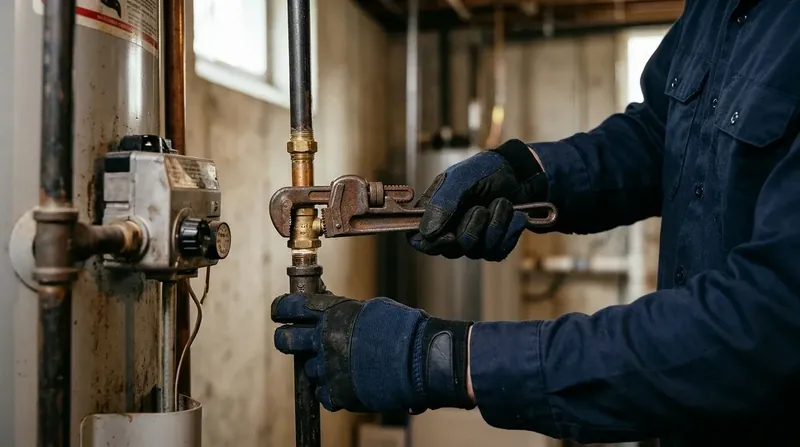
Water Heater Repair
Gas, electric and tankless repairs, from pilot lights to heating elements.
Learn more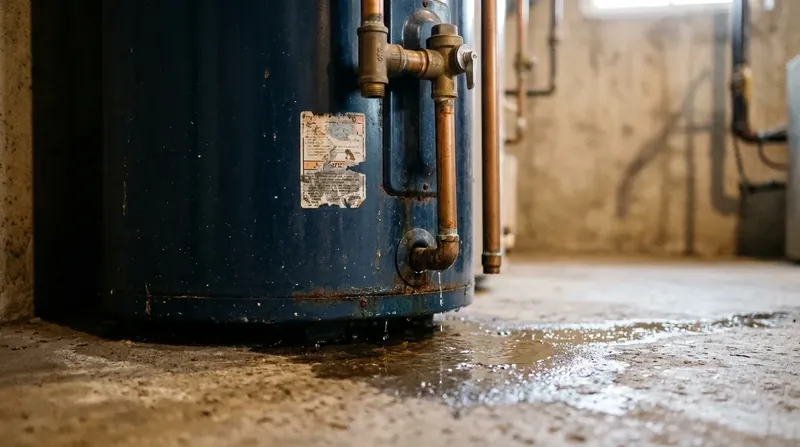
Leaking Water Heater
Water around the tank or a dripping relief valve. Act before it floods.
Learn more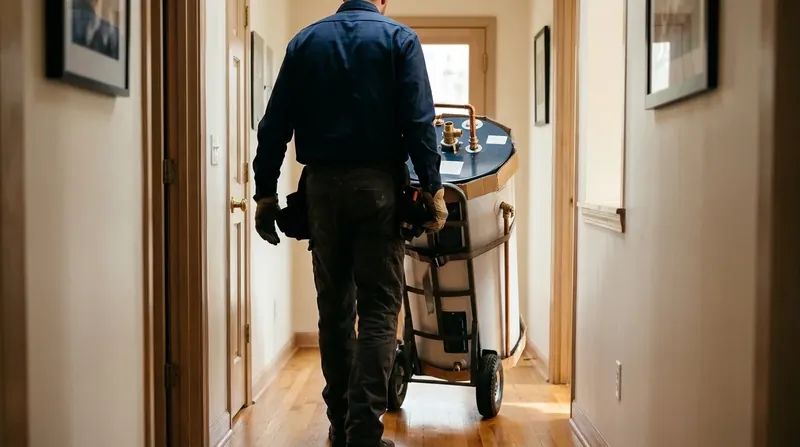
Water Heater Replacement
When repair no longer makes sense, get a new tank or tankless unit.
Learn moreCommon questions
Is an expansion tank required by code?
Under IPC 607.3, yes, when the water supply passes through a check valve, pressure-reducing valve or backflow preventer. Local codes vary, so ask your plumber or building department.
How do I know if my expansion tank is bad?
Run A. O. Smith's heating-cycle test. If pressure still climbs with a tank installed, the bladder may have failed, the air charge may be wrong, or the tank may be too small.
What pressure should my expansion tank be?
A. O. Smith and Watts both say to set the air charge to match your home's water pressure before installing it.
Sources
- A. O. Smith at Lowe's, Thermal Expansion Tanks
- International Plumbing Code 2021, Section 607.3 Thermal expansion control
- Watts, Expansion Tank Sizing Calculator (Potable)
- A. O. Smith, Water Heater Maintenance Guide
- City of Post Falls, 2023 Consumer Confidence Report
General information only. Gas, electrical and pressure work can be dangerous; when in doubt, call a licensed professional.
Still stuck? Get a plumber out.
Call now for water heater repair or replacement.