Water heater backdrafting: how to spot it and what causes it
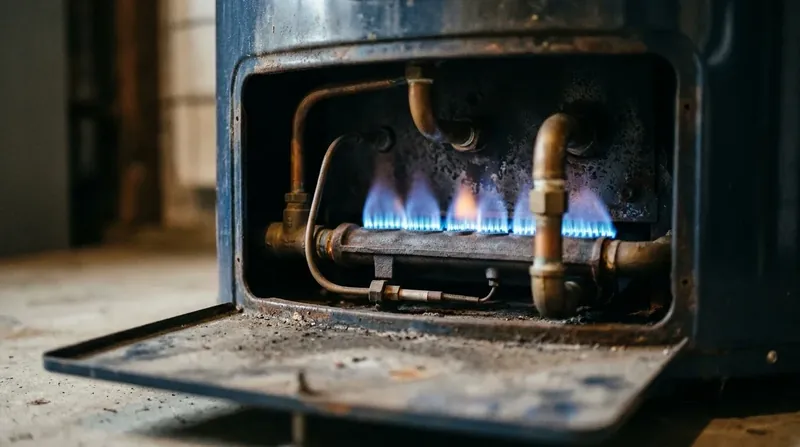
A standard gas water heater relies on hot exhaust rising up the vent on its own. When something stops that, the exhaust, carbon monoxide included, spills out into the room instead.
Updated October 26, 2026 · 6 min read · By the Heater Doctor team
Short answer
Backdrafting is when exhaust from a gas water heater comes out of the draft hood into the house instead of going up the vent. Look for melted plastic rings on the water pipes above the tank or soot on top of it. To test, after a shower, hold a match, long lighter or incense stick at the draft hood opening while the burner is on. If the flame or smoke is drawn in, it's venting properly. If it's pushed away, it's backdrafting. Turn the heater off and call a plumber.
How a natural-draft water heater vents
Most tank gas water heaters have a draft hood, a flared metal cap where the vent pipe meets the top of the tank. The Pacific Northwest National Laboratory, a U.S. Department of Energy lab, explains that openings under the hood let room air into the vent, where the burner's exhaust heats it. The hot air rises up the vent and out of the chimney, carrying the exhaust with it.
That only works if the vent can pull harder than the house. InterNACHI notes that these heaters have no fan, so exhaust rises by convection alone, which might not be strong enough to beat a drop in indoor air pressure. Power-vent heaters use a fan, and direct-vent heaters are sealed off from household air, so both are much less prone to it.
Signs it has backdrafted
- Melted plastic near the draft hood. Water heaters come with small plastic rings or sleeves on the water lines. Structure Tech, a Minnesota home inspection firm, calls melting on the side facing the draft hood a dead giveaway.
- Soot or dark residue on top of the tank. InterNACHI says soot indicates backdrafting, though its absence doesn't prove it never happened.
- A disconnected vent pipe. PNNL calls it a dangerous situation that lets carbon monoxide into the home.
- A vent pipe that slopes down. Exhaust is likely to back up and spill out of the hood, PNNL says.
- Rust on the vent or damage at the base of a chimney. InterNACHI explains that exhaust holds water vapor, and without proper draft it condenses inside the flue.
Melted plastic shows it happened at some point, not that it's happening now. The cause may already have been fixed, so a draft test is the next step.
The draft test
A. O. Smith's manual describes the test installers use after lighting a new heater. Let the burner run for 15 minutes. Turn on the other appliances in the area and close the doors. Then pass a match flame around the opening of the draft hood:
- A steady flame drawn into the opening means proper draft.
- A flame that flutters or blows out means exhaust is escaping. A. O. Smith says not to run the heater until the vent or air supply is repaired.
PNNL's version uses a long lighter or an incense stick after someone has showered, so the burner is running. It also suggests carrying a battery CO detector when you check, and installing a plug-in combination gas and CO alarm near the heater. Don't touch the vent pipe. It gets hot enough to burn.
Inspectors try to recreate the worst case by turning on the dryer and every exhaust fan first, InterNACHI says. If it only backdrafts with the fans running, that tells you the cause.
What causes it
- Exhaust fans and dryers. PNNL and InterNACHI both point to kitchen and bath fans, dryers and fireplaces pulling air out of a tight house. Structure Tech calls not enough combustion air the most common cause, and says if opening a window stops the backdraft, that's your answer.
- Vent pipe problems. A. O. Smith's manual says the vent connector must run without dips or sags and slope upward at least 1/4 inch per foot, with no unnecessary bends. It recommends at least 12 inches of straight vertical pipe on the draft hood before any elbow, and says existing vents must be inspected for blockage, corrosion and proper installation.
- An orphaned water heater. When a furnace sharing the chimney is replaced with a high-efficiency model that has its own vent, InterNACHI says the water heater is often left alone in a flue sized for both. Its exhaust isn't hot enough to draft properly, especially in a large masonry chimney.
- A blocked chimney. A. O. Smith says the chimney must be clear, and cleaned first if it was used for wood or a fireplace.
How it gets fixed
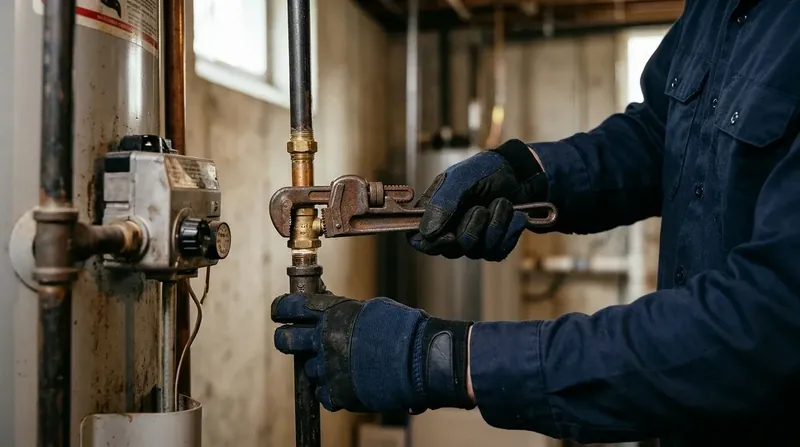
The fix depends on the cause. A badly pitched or loose connector gets re-run and screwed together. A house that's too tight needs a combustion air supply. InterNACHI says an orphaned heater in a masonry chimney usually needs a properly sized metal liner, and an oversized metal flue can be replaced with one sized for the heater. It also notes many orphaned heaters are near the end of their life, so replacing it with an electric, power-vent or direct-vent model can be the simpler answer. See our gas water heater repair page.
Older housing has more chimneys and shared flues. Nearly half of Wrightsville, Pennsylvania's homes were built before 1940, and almost three in four heat with gas (see our Wrightsville page). In Weymouth, Massachusetts, about 22% of homes date from before 1940 (see our Weymouth page).
Newer gas heaters also have a thermal switch that shuts the burner off when a blocked vent or poor combustion air overheats the combustion chamber. A. O. Smith says to fix the cause before resetting it. If yours keeps going out, see pilot light keeps going out.
Rather have a plumber look at it?
Call and describe what's happening. We'll get a plumber out to diagnose and fix it.
Call for service(858) 465-8561Local pages mentioned
Related water heater services
Common questions
How do I know if my water heater is backdrafting?
Hold a match or incense stick at the draft hood while the burner runs. If the flame or smoke is pulled in, it's drafting. If it's pushed away, exhaust is spilling into the house.
Is water heater backdrafting dangerous?
Yes. PNNL says a backdrafting gas appliance can let carbon monoxide into the home, which can be deadly. Turn it off and have it repaired.
What is an orphaned water heater?
A gas water heater left alone in a flue it used to share with a furnace. InterNACHI says its exhaust alone often isn't hot enough to draft properly.
Sources
- Pacific Northwest National Laboratory (U.S. DOE), Look for Signs of a Gas Water Heater Backdrafting
- InterNACHI, Backdrafting
- InterNACHI, Orphaned Water Heaters for Home Inspectors
- A. O. Smith, Residential Gas Water Heater with FVIR: Installation Instructions and Use & Care Guide
- Structure Tech Home Inspections, Water Heater Backdrafting: What if you can't reproduce the problem?
General information only. Gas, electrical and pressure work can be dangerous; when in doubt, call a licensed professional.
Still stuck? Get a plumber out.
Call now for water heater repair or replacement.