Water heater reset button keeps tripping: what's causing it
Pressing the red button brings the hot water back for a day, then it's cold again. That button isn't the problem; it's a safety switch reporting that the water got too hot. Here's what makes an electric tank overheat, how technicians test for each cause, and what's different on gas heaters.
Updated October 29, 2026 · 7 min read · By the Heater Doctor team
Short answer
The red reset button on an electric water heater is the high-limit switch, or energy cut-off (ECO). It trips when the tank overheats. Bradford White says repeated tripping is usually the result of a grounded heating element, which can keep heating nonstop. Its other causes are a thermostat that isn't flush against the tank, a thermostat stuck on or set too high, and a failed ECO. A. O. Smith adds that a faulty lower thermostat is a common trigger. On gas heaters, a tripping thermal switch usually points to a combustion air problem.
What the reset button actually does
On an electric tank, the reset button sits on top of the upper thermostat behind the upper access panel. It belongs to the high-limit switch, which Bradford White and A. O. Smith call the ECO (energy cut-off). When the tank water gets too hot, the ECO opens and cuts power to both elements. A. O. Smith's manual says that if the ECO has tripped, you'll have no hot water.
So a button that keeps tripping is doing its job. A. O. Smith says a tripped ECO can usually be reset, but a qualified person should find out why the tank overheated, and power shouldn't stay on until that's fixed.
Cause 1: a grounded heating element
This is the one to suspect first. Bradford White's service manual explains that an element shorted to ground will usually trip the breaker. But sometimes the current draw isn't high enough to trip it, and the element keeps heating continuously, "limited only by the ECO." Its conclusion: repeated tripping of the ECO is usually the result of a grounded element. A. O. Smith's troubleshooting guide likewise says the high-limit often trips because of a grounded element.
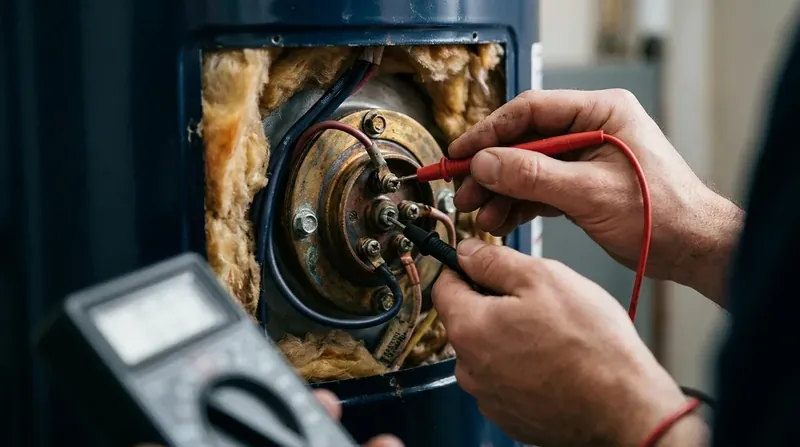
How it's tested: with the power off and the wires disconnected, touch one multimeter probe to an element screw terminal and the other to the element's metal flange. Bradford White says there should be no reading; any reading means the element is grounded and must be replaced. Repeat for the other terminal, and test both elements. (This is a different test from checking whether an element is burned out; see testing a bad element.)
Cause 2: a thermostat not touching the tank
Electric thermostats are surface-mounted: a bracket holds them against the side of the tank, and they read the tank's surface temperature to decide when to heat and when the ECO should trip. Bradford White says the entire back of the thermostat must be in full contact with the tank, and an improperly mounted thermostat leads to improper operation. The fix is to position the thermostat flush with the tank.
Cause 3: a thermostat stuck on
A thermostat whose contacts stick closed keeps an element running past the set point until the ECO trips. A. O. Smith's guide names a faulty lower thermostat as a common culprit. Bradford White's thermostat test procedure has a technician check for voltage across the thermostat terminals to see whether it's switching correctly, and it lists an inoperative thermostat among the causes of overheated water. Because these checks are done with the power on, they're best left to someone trained to work on live high-voltage circuits.
Cause 4: the thermostat set too high
Bradford White lists a thermostat set too high as a cause of water that's too hot. Thermostats ship at about 120°F from both Bradford White and A. O. Smith. Bradford White's fix is simply adjusting the thermostat to the desired setting (see what temperature a water heater should be).
Cause 5: a failed ECO
Sometimes the switch itself wears out and trips at too low a temperature or won't stay reset. Bradford White's high-limit test checks for voltage across the switch after a reset; if there's no voltage and the tank water is 120°F or cooler, the switch is defective. Bradford White's fix for an inoperative ECO is replacing the thermostat, because on its surface-mount controls the ECO and thermostat are one combination unit. Its manual also notes the limit can only be reset once the water has cooled to about 120°F; if the button won't stay in, the water may still be too hot.
Cause 6: loose or burned wiring
Bradford White's quick plan for troubleshooting an electric heater starts by turning the power off and checking that every wire connection is tight and free of corrosion. Loose connections show up in its charts for no hot water, not enough hot water and slow recovery. Lennox's reset guide adds damaged or corroded wiring and water leaking onto electrical parts to the list of reasons a reset won't hold. Browned insulation or a melted terminal is a job for a technician.
Quick reference
| Cause | Clue | Fix |
|---|---|---|
| Grounded element | May also trip the breaker in the panel | Replace the element |
| Thermostat not flush with tank | Thermostat loose in its bracket | Reseat the thermostat in its bracket |
| Thermostat stuck on | Water very hot before it trips | Replace the thermostat |
| Thermostat set too high | Dial at or near maximum | Turn it down |
| Failed ECO | Trips with the water barely warm | Replace the upper thermostat |
| Loose or burned wiring | Discolored wires or terminals | Repair connections |
Sources: Bradford White service manual and thermostat test procedure; A. O. Smith troubleshooting guide.
Gas water heaters: the thermal switch
Gas tanks don't have an ECO button behind a panel. Newer ones have a flammable vapor ignition resistant (FVIR) system with a resettable thermal switch. A. O. Smith says the switch can trip when the heater isn't getting enough air, and that improper installation or an inadequate air supply can make the FVIR system shut the heater down. If it trips more than once, look at the air supply: A. O. Smith points to a clogged air filter or flame arrestor at the base of older heaters, and its manual says the filter needs cleaning more often in linty or dusty spots. A. O. Smith warns never to disable or modify the thermal switch, because that can lead to fire, explosion or excess carbon monoxide. If clearing the air intake doesn't fix it, have the venting checked (see water heater venting and backdrafting).
Don't keep pressing it
Lennox warns that resetting again and again without fixing the cause can make things worse. A grounded element or stuck thermostat that keeps heating is exactly the condition the ECO is there to stop. The ECO is an electric-tank part, and census estimates on our town pages show about 60% of homes in Georgetown, Ohio and 52% in Mount Orab, Ohio heat with electricity. If the relief valve has also discharged hot water, A. O. Smith says to turn the power off and call a qualified person (see water heater relief valve leaking). For how to do the one reset safely, see how to reset a water heater; if it's the breaker in the panel that keeps tripping instead, see water heater keeps tripping the breaker.
Rather have a plumber look at it?
Call and describe what's happening. We'll get a plumber out to diagnose and fix it.
Call for service(858) 465-8561Local pages mentioned
Related water heater services
Common questions
Why does my hot water tank keep tripping the reset button?
The tank is overheating. Bradford White says repeated ECO tripping is usually caused by a grounded heating element; a thermostat not flush with the tank, a thermostat stuck on or set too high, and a failed ECO are the other causes.
Why does my water heater thermal switch keep tripping?
On gas FVIR heaters, A. O. Smith says the thermal switch can trip when the heater isn't getting enough combustion air. Clean the air filter or flame arrestor and clear space around the heater; if it keeps tripping, have the venting and installation checked.
How long do you hold the reset button on a water heater?
Just press it firmly until it clicks, with the power off at the breaker. If it won't stay in, Bradford White says the water may still be above about 120°F; let it cool first.
Can a bad element cause the reset button to trip?
Yes. Bradford White says an element shorted to ground can heat continuously without tripping the breaker, leaving only the ECO to stop it.
Is it safe to keep resetting my water heater?
No. Lennox warns that repeated resets without fixing the cause can make things worse. Reset it once; if it trips again, have the elements and thermostats checked.
Sources
- Bradford White, Service Manual: Residential and Light Duty Commercial Electric Water Heaters (238-54711-00A, rev. 5/22)
- Bradford White, Electric Thermostat Test Procedure
- A. O. Smith, Residential Electric Water Heater Installation Instructions and Use & Care Guide (100277323)
- A. O. Smith, Is Your Hot Water Not Getting Hot? Common Causes & What To Do
- A. O. Smith, Residential Standard Gas Water Heater Use and Care Guide (100277333, Oct. 2016)
- Lennox, How to Reset Your Water Heater
General information only. Gas, electrical and pressure work can be dangerous; when in doubt, call a licensed professional.
Still stuck? Get a plumber out.
Call now for water heater repair or replacement.