Electric water heater not heating: causes and fixes
An electric water heater has fewer parts than a gas one: two heating elements, one or two thermostats, a high-limit safety switch and the circuit that feeds them. That makes it easier to narrow down. Here is the order A. O. Smith's own electric water heater manual works through, and what each result means.
Updated October 29, 2026 · 8 min read · By the Heater Doctor team
Short answer
A. O. Smith's manual lists the most likely reasons for no hot water from an electric tank as: no power (a tripped breaker or wiring problem), a burned-out upper element, a tripped energy cut-off (the red reset button on the upper thermostat), a broken upper thermostat, reversed connections on a new install, or a leak on the hot side of the plumbing. If you get some hot water but not enough, it points to a thermostat set too low, a bad lower element or thermostat, low supply voltage, or a heater too small for the household.
Work safely first
A. O. Smith warns that working near an energized circuit can cause severe injury or death. Turn the breaker off before opening any panel, and confirm the power is off with a non-contact circuit tester. Put every cover back before turning power on. If you aren't comfortable with that, stop at the breaker check and call a technician.
No heat at all, or just not enough?
The answer points you to different parts. A standard electric tank has an upper and a lower element. On a typical tank they take turns rather than running together; Rheem, for one, bases its recovery rating on the elements not operating at the same time. A. O. Smith's manual splits the causes like this:
| Symptom | Most likely causes (A. O. Smith) |
|---|---|
| No hot water | No power; burned-out upper element; tripped energy cut-off (ECO); broken upper thermostat or wiring; reversed inlet and outlet (new installs); hot-side plumbing leak |
| Some hot water, not enough | Thermostat(s) set too low; bad lower element or lower thermostat; low supply voltage; heater too small for the household; reversed connections or melted dip tube (new installs); faulty mixing valve at one faucet; plumbing leak |
A. O. Smith notes that because the lower element does most of the work, it usually wears out before the upper one. In its words, a failed lower element (or, more rarely, lower thermostat) leaves you with some hot water but not as much as before. No hot water at all points to power, the upper element, the upper thermostat or the reset.
Step 1: check the power
A. O. Smith says no hot water is often caused by a problem with the home's wiring or circuit breakers, and lists "no electric power" as a common problem with new installations. Check the water heater's breaker first: if it's tripped, Lennox says to switch it fully off and then on. If it trips again, don't keep resetting it (see water heater keeps tripping the breaker).
If the breaker looks fine, the manual's test is to check both incoming power wires at the junction box on top of the heater with a non-contact tester. If the heater isn't getting power, it says to have a qualified person check the home's wiring or breakers.
Step 2: press the red reset (ECO) button
The energy cut-off, or ECO, is the red button on the upper thermostat behind the upper access panel. It cuts power to the elements if the tank water gets too hot. With the power off, fold back the insulation and press it.
- You hear a click: the ECO had tripped. A. O. Smith says that in most cases this means the tank overheated because of a problem with an element or thermostat, and a qualified person should check both elements and thermostats.
- No click: the ECO wasn't tripped, and A. O. Smith says the upper thermostat should be checked by a qualified person.
The manual also says not to restore power until the cause of the overheating has been found and repaired. More detail: how to reset a water heater.
Step 3: test the upper element
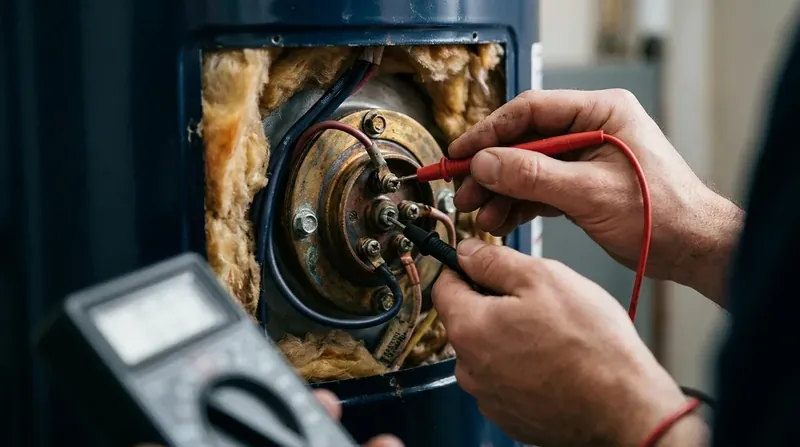
If the heater has power and the reset didn't fix it, test the upper element with a multimeter set to resistance. With the power off and both power wires removed from the element, measure across its two screw terminals. A. O. Smith says a good element reads between 5 and 25 ohms; outside that range, replace it. Test the lower element the same way. Our guide to testing a bad electric water heater element has photos and the replacement steps.
When you replace an element, A. O. Smith says to match the voltage and wattage on the heater's data plate, and not to turn the power back on until the tank is completely full of water.
Brand-new heater with no hot water? Think dry fire
A. O. Smith says that on a new heater, a burned-out upper element is almost always caused by turning the power on before the tank was completely full of water, which it calls a dry fire. Its installation steps say to open a hot faucet and let it run full for three minutes or longer to purge the air before connecting power. The company treats a dry-fired element as an installation error that its warranty doesn't cover. The other new-install culprit it names is reversed inlet and outlet connections.
Newer heaters with a digital thermostat
Some electric tanks, like the A. O. Smith model with an electronic thermostat covered in the same manual, report problems with a flashing LED instead of making you test parts. On that model, a green flash is normal and no light means no power to the control (check fuses and the breaker). Red flashes are codes, for example:
| Red flashes | Meaning (A. O. Smith model) |
|---|---|
| 1 | Dry fire: power on with the tank not full |
| 2 | Water exceeded the high limit; reset needed |
| 4 | Upper element circuit failure (lower still works) |
| 5 | Lower element circuit failure (upper still works) |
Codes differ by brand and model, so use the chart in your heater's manual or on its label.
Water warm but not hot
If every faucet runs warm but not hot, A. O. Smith's first check is the thermostat setting: it says its thermostats are factory set to about 120°F. If one faucet is cooler than the rest, the problem is probably that faucet's mixing valve, which A. O. Smith says can fail and cut hot water to that fixture even when the tank is full. Its other causes are a bad lower element or thermostat, low supply voltage, a hot-side plumbing leak and an undersized heater. See water heater not hot enough and what temperature a water heater should be.
Sediment matters on electric tanks too. A. O. Smith says minerals form lime deposits on the elements and sediment in the tank bottom, and that in very hard water it's often easier and cheaper to replace lime-encrusted elements than to clean them (see how to flush a water heater).
How long until it's hot again
Electric tanks are slow to recover. A. O. Smith says a 40 to 50 gallon electric tank takes about 60 to 90 minutes to reheat after the hot water runs out, so give a repair that long before deciding it didn't work. On a typical two-element tank only one element runs at a time, which is why recovery is slower than gas (see how long a water heater takes to heat up).
These checks matter most where electric heat is common. Census estimates on our town pages show about 61% of homes in Blanchester, Ohio and 67% in Boonsboro, Maryland heat with electricity.
When to call a technician
- The breaker trips again after you reset it.
- The ECO clicks when you press it, meaning the tank overheated. A. O. Smith says to have the elements and thermostats checked before running the heater.
- The heater isn't getting power at the junction box.
- The relief valve releases a lot of very hot water. A. O. Smith says that's likely a shorted element or, more rarely, a failed thermostat; turn the power off.
- You see water around the base (see water heater leaking from the bottom).
Lennox gives 8 to 12 years as a typical lifespan for a tank heater; past that, compare a repair with replacement costs before you spend.
Rather have a plumber look at it?
Call and describe what's happening. We'll get a plumber out to diagnose and fix it.
Call for service(858) 465-8561Local pages mentioned
Related water heater services
Common questions
Why is my electric water heater not getting hot?
A. O. Smith's most likely causes are no power, a burned-out upper element, a tripped energy cut-off (red reset button), a broken upper thermostat, reversed connections on a new install, or a hot-side plumbing leak.
How do I reset my electric water heater?
Turn the breaker off, remove the upper access panel, fold back the insulation and press the red ECO button on the upper thermostat. If it clicks, it had tripped, and A. O. Smith says the elements and thermostats should be checked to find out why.
How can you tell if a heating element is bad?
With the power off and the wires removed, measure across the element's two terminals with a multimeter. A. O. Smith says a good element reads 5 to 25 ohms; anything outside that range means replace it.
Why does my electric water heater have power but no hot water?
If the breaker is on and power reaches the heater, the usual suspects are a tripped ECO, a burned-out upper element or a failed upper thermostat.
Why did my new electric water heater stop heating?
A. O. Smith says a burned-out upper element on a new heater is almost always from a dry fire, turning the power on before the tank was full of water. Reversed inlet and outlet connections are the other common new-install problem.
How long do electric water heaters last?
Lennox gives 8 to 12 years for a typical tank water heater.
Sources
- A. O. Smith, Residential Electric Water Heater Installation Instructions and Use & Care Guide (100277323)
- A. O. Smith, Is Your Hot Water Not Getting Hot? Common Causes & What To Do
- A. O. Smith, How Long Does It Take a Water Heater to Heat Up?
- Rheem, Performance Platinum/Classic electric water heater specification sheet (recovery at 90°F rise)
- Lennox, Hot Water Heater Not Working? Here's What to Check (Mar. 2026)
General information only. Gas, electrical and pressure work can be dangerous; when in doubt, call a licensed professional.
Still stuck? Get a plumber out.
Call now for water heater repair or replacement.