Water heater leaking from the bottom: what it means
A puddle under the water heater doesn't always mean the tank is done. It can be condensation, a drain valve, or water running down from a fitting above. Here's how to narrow it down.
Updated October 26, 2026 · 6 min read · By the Heater Doctor team
Short answer
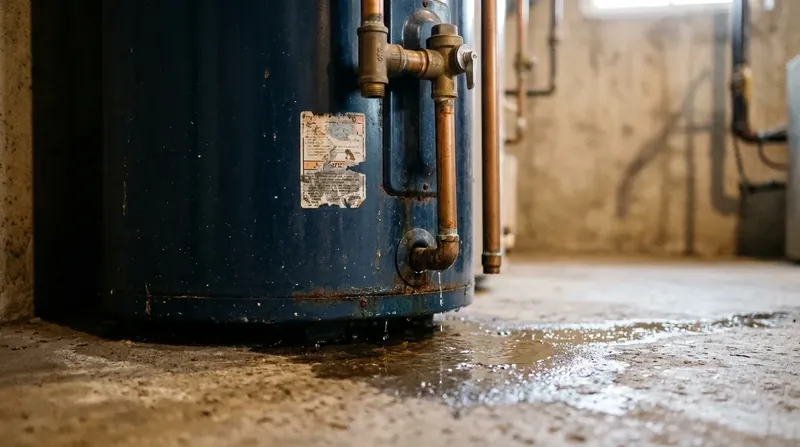
Water at the base of a water heater usually comes from one of four places: condensation, a loose or worn drain valve, a leak higher up that runs down the side, or the tank itself. A. O. Smith says a leaking tank can't be repaired and has to be replaced, but the other three often can be fixed. Find out which before you buy a new heater.
First, make it safe
A. O. Smith's leak guide says to turn off the power or gas before you inspect. For an electric heater, switch off its breaker. For gas, turn the control to off or pilot. If water is spreading, close the cold water valve on the pipe that feeds the top of the tank. Then dry the floor and the tank so you can see where new water appears.
If you smell gas, leave the house and call 911 and your gas company from outside. Don't look for the leak.
Is it condensation?
Condensation is the most common false alarm. A. O. Smith's Bulletin 15 explains that cold incoming water chills the tank and flue, and when the burner fires, water vapor in the flue gas condenses on those surfaces. A typical home gas water heater produces about half a gallon of water vapor every hour it runs. Newer, more efficient heaters condense more than old ones.
Bradford White describes it the same way: in winter, cold incoming water makes the tank sweat. You'll often see it after a long shower or when the heater has just been refilled, and you may hear a sizzle as drops hit the burner.
A. O. Smith's test for a gas heater: turn the thermostat knob to pilot, wait 8 hours, and check under the heater. Condensation stops once the whole tank is above about 115°F. Dry floor means it was condensation. Water still there means you need to look further.
Check the drain valve
The drain valve sits near the bottom of the tank, where a garden hose attaches. A. O. Smith's Bulletin 51 says to make sure it's closed tightly, and if the drip won't stop with the handle, the valve needs replacing. A cap on the hose threads is a short-term stopgap, not a fix.
Replacing a drain valve means draining the tank. On an old heater that's never been flushed, sediment can keep the new valve from sealing, so it's a good moment to decide whether the heater is worth the work.
Look up: water running down
Water at the base often starts higher. Bulletin 51 lists the relief valve and its discharge pipe, the inlet and outlet connections, the gas valve's threaded connection on gas models, and the element gaskets on electric models. In a warm or humid room, condensation can also run down the cold water pipe and the connections on top.
Run a dry paper towel over each fitting from the top down. If the relief valve's pipe is the source, see relief valve leaking. A dripping relief valve usually points to high pressure or thermal expansion, and a thermal expansion tank is often the fix.
When the tank itself is leaking
If the fittings and valves are dry and water keeps appearing under the heater, the tank has likely corroded through. A. O. Smith says leaking heaters can't be repaired. Its leak guide names hard water, sediment and a worn-out anode rod among the causes, and puts typical heater life at 8 to 20 years depending on type.
Hard water is common in some areas we cover. Meridian, Idaho reported city well water around 7 to 10.5 grains per gallon in 2025 (see our Meridian page). A tank leak doesn't usually fix itself or stay small, so turn off the cold supply and plan the replacement.
Why it's worth acting fast
Leaks get expensive quickly, and not just in damage. Caldwell, Idaho says it doesn't adjust water bills for leaks, and its city code holds the owner responsible for damage from them (see our Caldwell page). In Quincy, Massachusetts, water and sewer together run $28.56 per 100 cubic feet (see our Quincy page).
If your heater sits where a leak would damage floors or a finished room, the International Residential Code calls for a drain pan at least 1½ inches deep with a drain line. A pan won't stop a tank failure, but it buys time.
Rather have a plumber look at it?
Call and describe what's happening. We'll get a plumber out to diagnose and fix it.
Call for service(858) 465-8561Local pages mentioned
Related water heater services
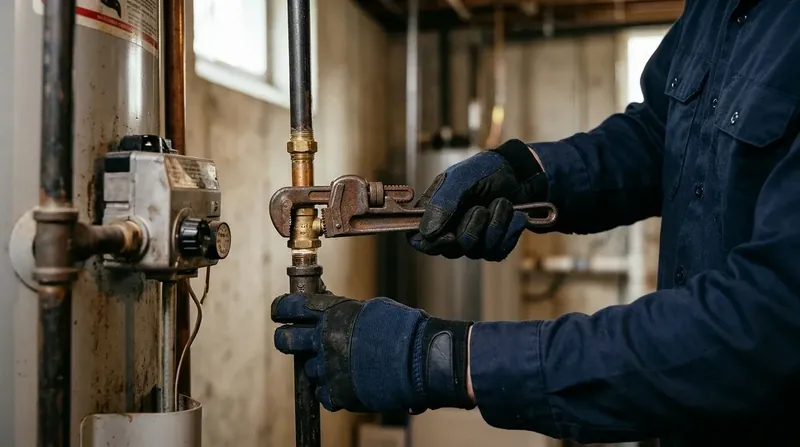
Water Heater Repair
Gas, electric and tankless repairs, from pilot lights to heating elements.
Learn moreLeaking Water Heater
Water around the tank or a dripping relief valve. Act before it floods.
Learn more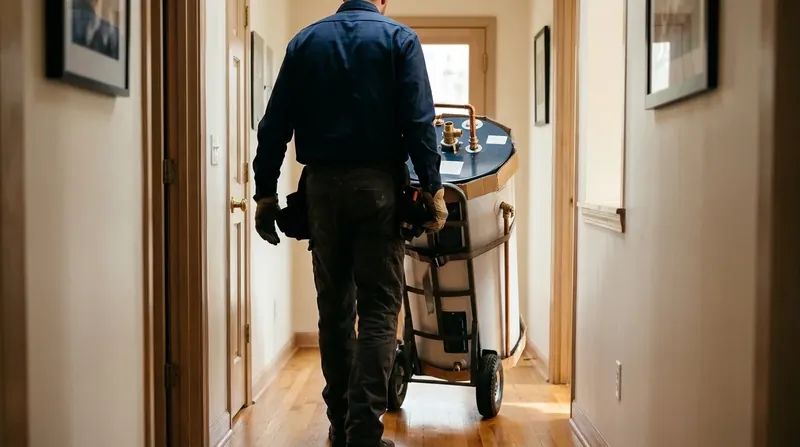
Water Heater Replacement
When repair no longer makes sense, get a new tank or tankless unit.
Learn moreCommon questions
Is it normal for a new water heater to drip?
A new gas heater can condense, especially in cold weather or after a long hot water draw. A. O. Smith says it should stop once the tank is above about 115°F. Water that keeps coming is a leak.
Can a leaking water heater tank be fixed?
No. A. O. Smith says if the tank itself is leaking, the heater has to be replaced. Leaks from the drain valve, relief valve or fittings can usually be repaired.
Is it safe to use a water heater that's leaking from the bottom?
Not for long. Turn off the power or gas and close the cold supply valve to limit the water, then get it checked before the leak gets worse.
Sources
- A. O. Smith, How to Diagnose, Fix, and Prevent Water Heater Leaks
- A. O. Smith, Technical Bulletin 15: Condensation
- A. O. Smith, Technical Bulletin 51: Puddle on Floor
- Bradford White, Condensation (all residential and commercial gas units)
- International Residential Code 2018, Section P2801.6.1 Pan size and drain
General information only. Gas, electrical and pressure work can be dangerous; when in doubt, call a licensed professional.
Still stuck? Get a plumber out.
Call now for water heater repair or replacement.