How to flush a tankless water heater
Tankless heaters don't collect sediment in a tank, but hard water leaves scale inside the heat exchanger. Flushing, also called descaling, pumps a mild acid through it to dissolve that scale. The steps are simple, but the brands don't agree on the details.
Updated October 26, 2026 · 7 min read · By the Heater Doctor team
Short answer
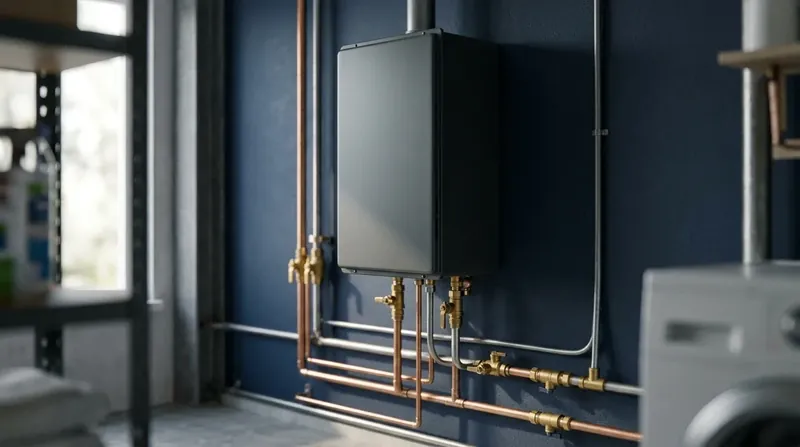
To flush a tankless water heater, turn off its gas or power, close the hot and cold isolation valves, hook a small pump and hoses to the service ports, and circulate white vinegar from a bucket through the heat exchanger for 45 minutes to an hour, depending on the brand. Then rinse with fresh water for 5 to 10 minutes, clean the inlet filter and restart. Rinnai and Navien say to do it at least once a year.
Why tankless heaters need flushing
Rinnai's installation manual says scale build-up is caused by hard water and speeds up when the heater is set to a high temperature. In a lab study for the Water Quality Research Foundation, Battelle estimated that a tankless heater run at 140°F builds about twice the scale it would at 120°F. Rinnai says scale affects the heater's performance and that failing to flush will damage the heat exchanger.
This is different from draining a tank heater, which flushes loose sediment out of the bottom. For tank models, see how to flush a water heater.
Signs it's due: LC and service codes
Rinnai heaters show LC (or LC0 to LC9, or 00) when scale has built up in the heat exchanger. Rinnai's diagnostic code guide says older models keep running and can be cleared by switching the power off and on, while newer models lock out to prevent damage. Pressing the on/off button on the controller five times lets the heater run for about 70 more hours, and each reset without a flush raises the number after LC. After the flush, a technician clears the count.
Some models also show a flushing reminder: an SS (Service Soon) code on Rinnai's N series, if it's turned on in the settings, and code T111 on Rheem's condensing models. If the water is lukewarm with no code, see tankless water heater not heating for other causes.
How often to flush
Rinnai and Navien both say at least once a year. Rheem's condensing manual says annually or as a professional recommends, based on your water and how much hot water you use. Navien adds that harder water, higher temperature settings and heavier use all mean more frequent descaling, and Rinnai's manual says homes with hard water may need a more frequent schedule and should treat the water.
Rinnai's N series manual lists a maximum total hardness of 200 mg/L for the water feeding its heaters. Local water can top that: the City of Lancaster's 2025 analysis measured its Conestoga plant water at 235 mg/L (see our Lancaster page). In Camp Hill, Pennsylvania American Water's 2025 report lists West Shore plant water at 144 mg/L, about 8 grains per gallon, which is under that limit but still moderately hard (see our Camp Hill page). Your utility's water quality report gives the number for your home; a softener is covered in water softeners and water heaters.
What you need
- Isolation valves with service ports on the hot and cold lines at the heater. Rinnai strongly recommends them for flushing, and Rheem sells them as an accessory. Without them, a plumber has to add them first.
- A small submersible or circulating pump and two hoses that fit the service ports. Rheem sells a flush kit that includes a circulating pump.
- A 5-gallon bucket.
- The cleaning solution your manual names. Rinnai calls for undiluted food-grade white vinegar and says never to use chemical solutions. Navien allows white vinegar or an approved tankless descaling solution.
The brands disagree, so check your manual
Here is what each manufacturer's own instructions say:
| Brand | Solution | Circulate | Rinse |
|---|---|---|---|
| Rinnai (N series manual) | 4 gallons undiluted white vinegar | At least 1 hour, pump at 4 gallons per minute | 5 minutes |
| Navien | White vinegar or approved descaler | At least 45 minutes | At least 10 minutes |
| Noritz | 3 to 4 gallons white vinegar | At least 1 hour | At least 5 minutes or 20 gallons |
| Rheem (condensing manual) | No more than 2 gallons white vinegar | 45 minutes | 5 minutes |
They also differ on power. Rinnai and Rheem say to disconnect electrical power. Noritz says to keep the unit on with the gas turned off, and warns that an error code 11 will appear during the flush, which is normal; don't reset it until you're done. Rheem's manual also says to set the highest temperature first and recommends going back to 120°F after the flush.
Step by step
These steps follow Rinnai's manual. Swap in your brand's amounts and times from the table above.
- Turn off the heater at the controller, then disconnect its electrical power and close the gas valve below it.
- Close the main hot and cold isolation valves.
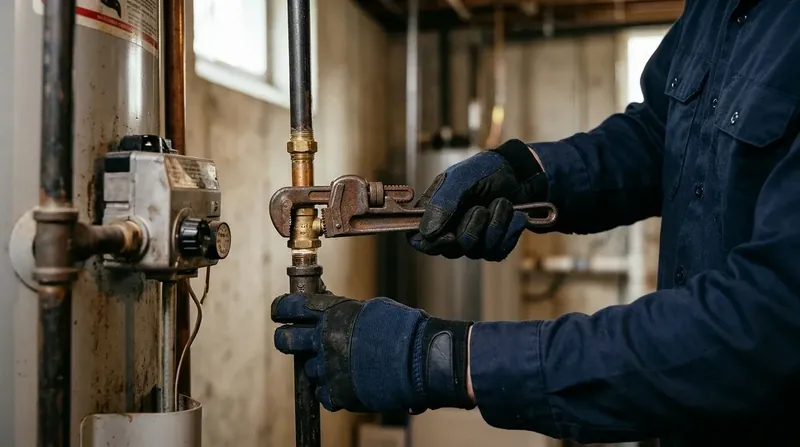
- Remove the caps from the service (purge) ports slowly. Connect the pump's outlet hose to the cold-side port and a drain hose to the hot-side port.
- Pour the vinegar into the bucket and put the pump and the end of the drain hose in it.
- Open both service ports and run the pump so the vinegar circulates through the heater and back into the bucket.
- Turn the pump off. Move the drain hose to a sink or outside, close the cold service port and open the main cold valve. Let fresh water run through for the rinse time.
- Close the main cold valve, remove the inlet water filter on the cold side, rinse it clean and put it back. Open the cold valve again.
- Close the hot service port, open the main hot valve, disconnect the hoses and replace the port caps.
- Restore power and gas. Open a hot tap slowly; Rinnai says it can take 2 to 3 minutes for the air to clear.
If you smell gas at any point, leave the house and call your gas company from outside.
Warranty and when to call a pro
Rinnai's manual says damage caused by lime build-up is not covered by the warranty and lists improper maintenance, including scale build-up, as an exclusion. It also says the heater must be inspected every year by a trained and qualified professional. Navien warns that descaling done incorrectly can damage the heater and void the warranty, and recommends a professional for that reason. See water heater warranty for what else voids coverage.
Call for help if there are no isolation valves, the LC or error code returns soon after a flush, or the heater still won't heat. Our tankless water heater repair page covers those calls.
Rather have a plumber look at it?
Call and describe what's happening. We'll get a plumber out to diagnose and fix it.
Call for service(858) 465-8561Local pages mentioned
Related water heater services
Common questions
Can I flush a tankless water heater with vinegar?
Yes. Rinnai, Navien, Noritz and Rheem all list white vinegar. Rinnai calls for undiluted food-grade white vinegar and says never to use chemical solutions; Navien also allows an approved descaling solution.
How long should vinegar run through a tankless water heater?
Rinnai and Noritz say at least one hour. Navien says at least 45 minutes, and Rheem's condensing manual says 45 minutes.
What does LC mean on a Rinnai tankless water heater?
LC (or LC0 to LC9) means scale has built up in the heat exchanger and it needs flushing. Newer Rinnai models lock out until it's addressed; pressing the on/off button five times allows about 70 more hours of use.
How often should a tankless water heater be flushed?
Rinnai and Navien say at least once a year. Hard water, higher temperature settings and heavy use can mean more often.
Sources
- Rinnai, N Series Residential Condensing Tankless Water Heater Installation and Operation Manual
- Rinnai, 13-Step Tankless Water Heater Flushing Procedure
- Rinnai, Troubleshooting Tankless Water Heater Diagnostic Codes
- Navien, How to Descale Your Tankless Water Heater
- Noritz, How to Descale a Noritz Tankless Water Heater
- Rheem, Condensing Tankless Water Heater Use and Care Manual (AP22745)
- Water Quality Association, WQRF Softened Water Benefits Study: Energy Savings (Battelle)
- City of Lancaster, 2025 yearly water analysis report
- Pennsylvania American Water, 2025 Mechanicsburg system water quality report
General information only. Gas, electrical and pressure work can be dangerous; when in doubt, call a licensed professional.
Still stuck? Get a plumber out.
Call now for water heater repair or replacement.