Water heater drain pan: when you need one and how it should be set up
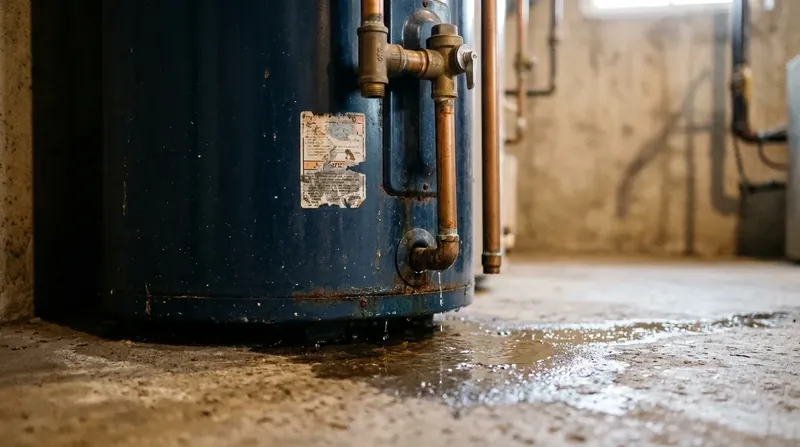
Every tank leaks eventually. A drain pan is the cheap part that decides whether that leak is a wet floor or a ruined ceiling below.
Updated October 26, 2026 · 5 min read · By the Heater Doctor team
Short answer
A water heater drain pan is a shallow tray under the tank, piped to a drain, that catches drips and slow leaks. The International Residential Code, the model code many states and towns adopt, requires one wherever a leak would cause damage, such as in an attic, a closet over living space or a finished basement. It must be at least 1-1/2 inches deep with a drain of at least 3/4 inch. Massachusetts has its own rule: a pan is required when the heater sits above occupied space. A plastic pan under a gas water heater has to meet a fire rating.
Why a pan matters
A. O. Smith's installation manual is blunt about it: because of the normal corrosive action of water, the tank will eventually leak. It says to install the heater where a leak from the tank or connections won't damage the area next to it or the floors below. Where that's not possible, it calls for a metal drain pan piped to a drain, to catch condensation and leaks from the tank or piping connections.
A pan is sized for drips and slow leaks. It buys time and sends the water somewhere harmless, but it won't hold a tank's worth of water if it splits. Our guide to a water heater leaking from the bottom helps you tell condensation from a failing tank.
When the code requires one
Under section P2801.6 of the 2018 International Residential Code, a tank-type water heater installed where leakage would cause damage must sit in a pan. The code's pan rules:
- Depth: at least 1-1/2 inches, big enough to catch drips or condensation from the tank.
- Drain: an indirect waste pipe at least 3/4 inch in diameter, running full size to a suitable drain, or outside to end 6 to 24 inches above the ground.
- Gas heaters: a plastic pan under a gas-fired heater must have a flame spread index of 25 or less and a smoke-developed index of 450 or less. The International Plumbing Code goes further and doesn't allow a plastic pan under a gas heater at all.
- Replacements: where no pan drain was installed before, a replacement water heater doesn't require one.
States and towns adopt different editions with their own amendments, so the local inspector has the final word. A. O. Smith's own instructions ask for a metal pan at least 2 inches wider than the heater that limits water to 1-3/4 inches deep, and warn that the pan must not block combustion air to a gas burner.
The Massachusetts rule
Massachusetts writes its own plumbing code, 248 CMR. Section 10.12 calls them safe waste pans, and requires one under any water heater or storage tank of 6 gallons or more that sits above an occupied space. Its rules:
- At least 2 inches deep, with at least 2 inches of clearance around the base of the heater.
- A waste pipe of at least 1 inch, piped indirectly to a trapped and vented fixture, or to within 12 inches of the lowest floor.
- When a replacement makes the drain piping impractical, the state allows a pan without the drain if a product-accepted automatic water heater shutoff device is installed and the relief valve discharges into the pan.
This matters most in apartment and condo buildings. About 40% of Quincy's homes are in buildings with five or more units (see our Quincy page). In Hingham, about 16% are in buildings with 50 or more units, where the heater may belong to the condo association (see our Hingham page).
A pan with no drain
Plenty of basements have a pan with no drain line, or a heater sitting on the floor next to a floor drain. A pan without a drain still catches drips, but it fills and overflows on a steady leak. If there's nowhere to pipe it, a leak alarm or a shutoff valve that closes the cold supply when it senses water gives you warning, and in Massachusetts that combination is the state's accepted alternative for replacements.
Check the pan when you flush the tank. Water sitting in it, rust stains or a corroded pan are clues worth following up.
Adding one to an existing heater
A pan goes under the heater, so adding one later means draining and disconnecting the tank, lifting it into the pan and reconnecting it. That's why it's usually done at replacement time. If your heater is near the end of its life anyway, see how old your water heater is and our replacement page.
Rather have a plumber look at it?
Call and describe what's happening. We'll get a plumber out to diagnose and fix it.
Call for service(858) 465-8561Local pages mentioned
Related water heater services
Water Heater Repair
Gas, electric and tankless repairs, from pilot lights to heating elements.
Learn moreLeaking Water Heater
Water around the tank or a dripping relief valve. Act before it floods.
Learn more
Water Heater Replacement
When repair no longer makes sense, get a new tank or tankless unit.
Learn moreCommon questions
Is a drain pan required under a water heater?
Under the International Residential Code, yes, wherever a leak would cause damage. Massachusetts requires one when the heater is above occupied space. Local codes vary.
Can I use a plastic pan under a gas water heater?
The IRC allows plastic only if it meets a flame spread index of 25 or less and a smoke-developed index of 450 or less. The International Plumbing Code bans plastic pans under gas heaters.
How deep does a water heater pan have to be?
At least 1-1/2 inches under the IRC, with a 3/4-inch drain. Massachusetts requires at least 2 inches deep and a 1-inch drain.
Sources
- A. O. Smith, Residential Gas Water Heater with FVIR: Installation Instructions and Use & Care Guide
- International Residential Code 2018, Section P2801.6 Required pan
- International Residential Code 2018, Section P2801.6.1 Pan size and drain
- International Plumbing Code 2021, Section 504.7 Required pan
- 248 CMR 10.12, Massachusetts Plumbing Code: Indirect Waste Piping (safe waste pans)
- Massachusetts Board of State Examiners of Plumbers and Gas Fitters, Safe Waste Pans for Water Heaters and Storage Tanks
General information only. Gas, electrical and pressure work can be dangerous; when in doubt, call a licensed professional.
Still stuck? Get a plumber out.
Call now for water heater repair or replacement.