How to adjust the thermostat on an electric water heater
Unlike a gas heater with its knob on the front, an electric water heater hides its thermostats behind access panels, usually two of them. Adjusting them takes ten minutes and a screwdriver, but it means working next to high-voltage wiring, so the order of steps matters. Here's how A. O. Smith says to do it.
Updated October 29, 2026 · 6 min read · By the Heater Doctor team
Short answer
Turn the power off at the breaker and confirm it's off with a circuit tester. Remove the upper and lower access panels, fold back the insulation, and turn each thermostat dial with a flat-blade screwdriver: clockwise for hotter, counterclockwise for cooler. A. O. Smith says to set both thermostats to the same temperature, and never set the upper one higher than the lower. Replace the insulation and panels, turn the power back on, and check the water at a faucet after it has had time to heat.
Before you start
- Tools: a Phillips screwdriver for the panels, a flat-blade screwdriver for the dials, a non-contact circuit tester and a kitchen thermometer.
- Know your target. A. O. Smith presets its heaters to 120°F, and the Department of Energy and CPSC recommend 120°F for most homes (see what temperature a water heater should be).
- Know the risk. A. O. Smith warns that working near an energized circuit can cause severe injury or death. If you aren't comfortable with that, an electrician or service technician can do it.
Step by step
- Turn off the power at the water heater's breaker (or remove its fuses).
- Confirm it's off. A. O. Smith says to remove the junction box cover on top of the heater and check the wires with a circuit tester.
- Remove the access panels. Most electric tanks have an upper and a lower panel, each covering an element and thermostat. A. O. Smith notes that some models have only one thermostat, in the lower panel.
- Fold the insulation back gently. Don't touch the wiring.
- Turn the dial with a flat-blade screwdriver: clockwise to raise the temperature, counterclockwise to lower it. A. O. Smith says most residential electric thermostats range from about 95°F to 150°F.
- Set the second thermostat to match. A. O. Smith says to adjust both to the same setting.
- Put it back together. Push the insulation back so it covers the thermostat, replace the panels and the junction box cover.
- Turn the power on and wait. A. O. Smith's manual says a full tank of cold water may take several hours to heat; after a small change, check the water once it has had time to recover.
Should the upper and lower thermostats match?
Yes. A. O. Smith says to set both thermostats to the same temperature, and specifically not to set the upper thermostat higher than the lower one, to avoid running short of usable hot water. Bradford White's test procedure explains why the order matters: the upper thermostat switches power to the lower one only once the top of the tank is satisfied.
Check the result with a thermometer
The marks on the dial are approximate. The CPSC suggests holding a candy or meat thermometer under a running hot tap first thing in the morning, or at least two hours after anyone used hot water. If you raised the setting, A. O. Smith warns that you could scald yourself while checking, and recommends thermostatic mixing valves at the taps for any setting above 120°F (see water heater too hot).
What about A, B and C on a gas heater?
Gas heaters use a knob on the gas control instead. The letters mean different temperatures on different models. On the A. O. Smith gas control in its manual, they're approximately: A = 128°F, B = 138°F, C = 147°F, with a VERY HOT mark at 160°F and a vacation setting near 55°F. So on that model, 120°F sits below A. Check the label or manual for yours, and confirm with a thermometer.
How to tell if a thermostat is bad
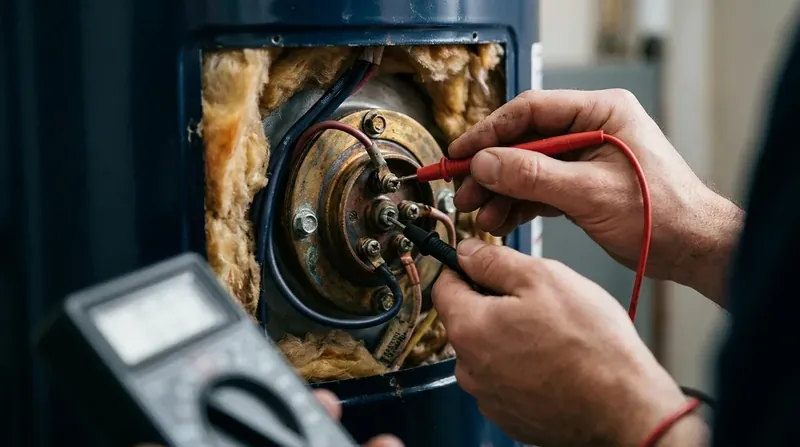
Signs include no hot water with the breaker on and the reset button not tripped, water much hotter than the setting, or a reset that keeps tripping. Bradford White's test procedure, meant for someone qualified to work on live circuits, checks each thermostat with a voltmeter:
- Upper thermostat: with the elements known to be good, turn the upper dial to its highest setting. If the tank water is 30°F or more below that setting, the thermostat should switch on and line voltage should appear across the upper element's terminals. No voltage means the thermostat isn't switching and must be replaced.
- Lower thermostat: set the upper dial to its lowest and the lower dial to its highest. Once the top of the tank is satisfied, you should hear a click as the upper thermostat passes power to the lower one, and see voltage at the lower element.
Bradford White also says the thermostat's back must sit flush against the tank, because it senses tank surface temperature. A thermostat pushed away from the tank, or one that's failed, can overheat the water (see reset button keeps tripping). Bradford White says element failure is the most common cause of electric water heater problems and recommends checking elements first (see testing a bad element).
When adjusting doesn't help
If the water stays lukewarm whatever the setting, a lower element or lower thermostat has probably failed; A. O. Smith says a bad lower element leaves you some hot water but less than before. If there's no hot water at all, see electric water heater not heating. For homes with digital controls, A. O. Smith says the temperature is set with buttons on the control, in the same 95°F to 150°F range.
Rather have a plumber look at it?
Call and describe what's happening. We'll get a plumber out to diagnose and fix it.
Call for service(858) 465-8561
Common questions
Can I adjust the temperature on my electric water heater myself?
Yes, if you're comfortable working near wiring. Turn the power off at the breaker, confirm it's off with a tester, remove the panels and turn each dial with a flat-blade screwdriver.
Should upper and lower thermostats be set the same on a water heater?
Yes. A. O. Smith says to set both to the same temperature, and never set the upper thermostat higher than the lower one.
Which way do I turn the thermostat to make the water hotter?
Clockwise raises the temperature and counterclockwise lowers it, according to A. O. Smith.
Should my hot water heater be on A, B or C?
It depends on the model. On the A. O. Smith gas control in its manual, A is about 128°F, B about 138°F and C about 147°F, all above the 120°F the DOE and CPSC recommend. Check your heater's label.
How long after adjusting will the water change temperature?
Give it time to recover before testing. A. O. Smith's electric manual says a whole tank of cold water can take several hours to heat; for a small change, test after the tank has recovered.
Sources
- A. O. Smith, How to Adjust Water Heater Temperature
- A. O. Smith, Residential Electric Water Heater Installation Instructions and Use & Care Guide (100277323)
- A. O. Smith, Residential Standard Gas Water Heater Use and Care Guide (100277333, Oct. 2016)
- Bradford White, Electric Thermostat Test Procedure
- Bradford White, Service Manual: Residential and Light Duty Commercial Electric Water Heaters (238-54711-00A, rev. 5/22)
- U.S. Consumer Product Safety Commission, Avoiding Tap Water Scalds
- U.S. Department of Energy, Energy Saver Guide (2022)
General information only. Gas, electrical and pressure work can be dangerous; when in doubt, call a licensed professional.
Still stuck? Get a plumber out.
Call now for water heater repair or replacement.