Water heater too hot: why it happens and how to fix it
Hot water that makes you jump back from the tap is more than uncomfortable. At 140°F, a serious burn takes less than five seconds. Here's how to measure your water, what makes a heater run too hot, and when overheating means a part has failed.
Updated October 29, 2026 · 7 min read · By the Heater Doctor team
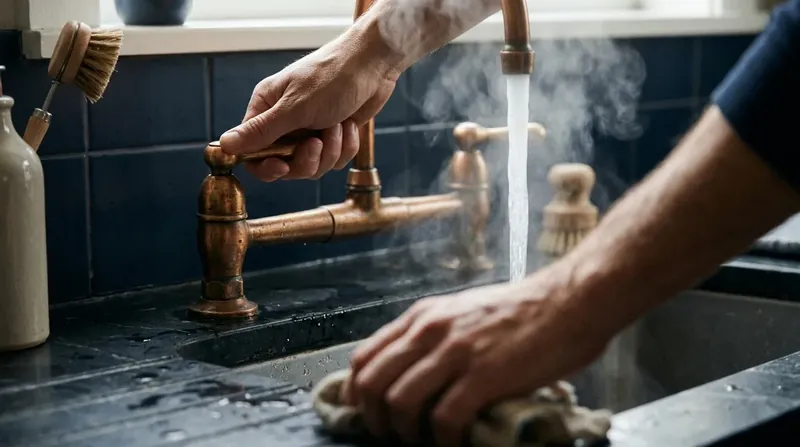
Short answer
Most often the thermostat is simply set too high. Other causes: "stacking," where many short draws leave the top of the tank up to 30°F hotter than the setting, which A. O. Smith calls normal; a failed thermostat or gas control; on electric tanks, a shorted heating element or a thermostat not sitting flush against the tank; and a heater in a very hot room. Turn the setting down to about 120°F, which the Department of Energy and CPSC recommend. If the water stays scalding, or the relief valve discharges hot water, shut the heater off and have it checked.
How hot is too hot?
A. O. Smith's manuals print how quickly hot water causes a serious burn:
| Water temperature | Time to a serious burn |
|---|---|
| 120°F | More than 5 minutes |
| 125°F | 1½ to 2 minutes |
| 130°F | About 30 seconds |
| 135°F | About 10 seconds |
| 140°F | Less than 5 seconds |
| 145°F | Less than 3 seconds |
| 150°F | About 1½ seconds |
| 155°F | About 1 second |
The CPSC says most tap water scald injuries and deaths are among older adults and children under five, and urges households to set water heaters to 120°F. The Department of Energy recommends the same setting.
Measure it first
Dials often show marks or letters instead of degrees, so measure. The CPSC suggests holding a candy or meat thermometer under a running hot tap first thing in the morning, or at least two hours after anyone used hot water. Let the tap run until the temperature stops rising. Check more than one faucet: if only one is scalding, the problem may be that fixture's mixing valve rather than the heater.
Cause 1: the setting is too high
A. O. Smith factory-sets its electric thermostats to about 120°F and its gas controls to their lowest setting. If someone turned the dial up, the fix is turning it back. On the A. O. Smith gas control in its manual, the marks run approximately: A = 128°F, B = 138°F, C = 147°F and VERY HOT = 160°F; other models differ, so check your label. Electric tanks usually have two thermostats behind two panels; turn the power off first. Step-by-step instructions are in what temperature a water heater should be.
Cause 2: stacking
A. O. Smith says repeated small draws of hot water can make the hot and cold water in a tank stack in layers, and the water at the top can be as much as thirty degrees hotter than the thermostat setting. It calls this a result of usage patterns, not a malfunction. It's one reason the company recommends thermostatic mixing valves at the taps, especially if you set the tank above 120°F.
Cause 3: a failed thermostat, element or gas control
When the setting is reasonable but the water keeps getting hotter, a part has usually failed. Bradford White's service manual lists these causes of overheated water on electric tanks:
- A thermostat not in contact with the tank. Electric thermostats sense the tank's surface temperature, and Bradford White says the whole back of the thermostat must sit flush against the tank.
- A grounded heating element, which can heat continuously until the high-limit trips.
- A thermostat that has failed and won't switch off.
- A failed high-limit (ECO) that no longer cuts power when it should.
A. O. Smith's electric manual says a nonfunctioning thermostat or a shorted element can cause extremely hot water, and very high temperatures can trip the energy cut-off (see reset button keeps tripping). On gas heaters, its manual says problems with the gas control valve can produce higher than expected temperatures; a failed control is replaced, not repaired (see water heater gas valve).
Cause 4: a hot room
A. O. Smith notes that if a water heater sits in a hot environment, the water in the tank can become as hot as the surrounding air, regardless of the setting.
When too hot is an emergency
Turn the heater off (power at the breaker, or the gas control to off) and call a technician if:
- the relief valve is discharging a large amount of very hot water, which A. O. Smith says can mean the tank is overheating;
- the water is still scalding after you turn the setting down and give the tank time to cool.
Never cap or plug the relief valve. A. O. Smith says that could cause an explosion (see can a water heater explode).
Mixing valves and shower limit stops
If you keep the tank hotter for capacity or to control bacteria, A. O. Smith recommends thermostatic mixing valves at each point of use, set no higher than 120°F; they blend hot and cold water to limit the temperature at the tap. Most single-handle shower valves also have a limit stop that caps how far the handle turns toward hot, and Delta and Moen both explain how to adjust theirs. Our guide to water heater not hot enough covers the opposite problem, including stops set too low.
Rather have a plumber look at it?
Call and describe what's happening. We'll get a plumber out to diagnose and fix it.
Call for service(858) 465-8561Related water heater services
Common questions
Why is my hot water suddenly too hot?
If nobody changed the setting, suspect a failed thermostat or gas control, or on an electric tank a grounded element or a thermostat that's come loose from the tank. Bradford White lists all of these as causes of overheated water.
What temperature should my water heater be set at?
About 120°F, the setting the Department of Energy and CPSC recommend. A. O. Smith's table shows 120°F water takes more than 5 minutes to cause a serious burn, against less than 5 seconds at 140°F.
Can a water heater get too hot and explode?
Overheating raises pressure, which is what the temperature and pressure relief valve is for. A. O. Smith says an explosion could occur if that valve or its discharge pipe is blocked.
Why is the water hotter than my thermostat setting?
A. O. Smith says repeated small draws can stack hot water at the top of the tank up to 30°F above the setting. It's normal, but a mixing valve at the tap helps.
How do I lower my water heater temperature?
Turn the gas control knob toward a lower mark, or on an electric tank turn the power off, open the access panels and adjust both thermostats with a screwdriver. Re-check with a thermometer after a few hours.
Sources
- A. O. Smith, Residential Standard Gas Water Heater Use and Care Guide (100277333, Oct. 2016)
- A. O. Smith, Residential Electric Water Heater Installation Instructions and Use & Care Guide (100277323)
- Bradford White, Service Manual: Residential and Light Duty Commercial Electric Water Heaters (238-54711-00A, rev. 5/22)
- U.S. Consumer Product Safety Commission, Avoiding Tap Water Scalds
- U.S. Department of Energy, Energy Saver Guide (2022)
- Delta Faucet, How do I set the adjustable rotational limit stop on my bath or shower?
- Moen, How to Adjust the PosiTemp Temperature Limit Stop
- A. O. Smith, Service Handbook: Residential FVIR Gas Water Heaters (Honeywell gas control valve models)
General information only. Gas, electrical and pressure work can be dangerous; when in doubt, call a licensed professional.
Still stuck? Get a plumber out.
Call now for water heater repair or replacement.