Water heater drain valve leaking: causes and fixes
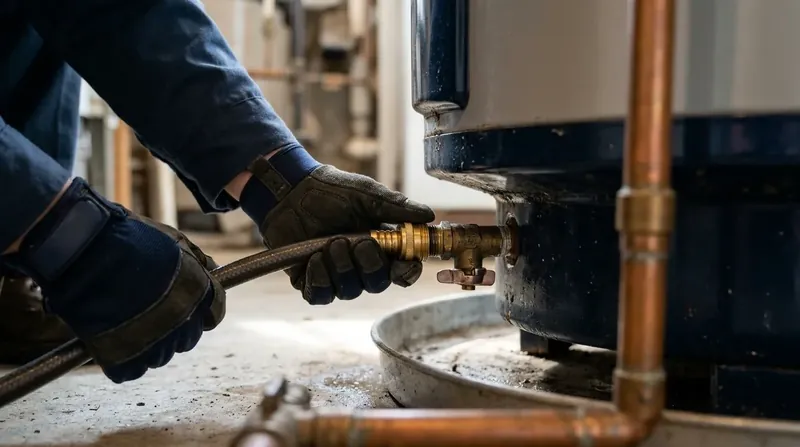
The drain valve is the spigot near the bottom of the tank where a hose connects. When it drips, it's usually one of three things, and only one of them needs the tank drained.
Updated October 26, 2026 · 5 min read · By the Heater Doctor team
Short answer
A drain valve that drips is usually not fully closed, has a bit of sediment stuck in its seat, or has a worn seal. A. O. Smith's Bulletin 51 says to make sure it's closed tightly first, and if the leak won't stop at the handle, replace the valve. Replacing it means shutting off the heater and draining the tank, so a hose cap can hold it until the job is done.
Make sure it's really the drain valve
Dry the valve and the tank around it, then watch. Water that appears at the valve's outlet or around its stem is the valve. Water that runs down the tank from above is something else, often the relief valve pipe or a top fitting. Water that seeps from under the tank's jacket with the valve dry is more serious. See water heater leaking from the bottom.
Not fully closed
Bulletin 51's first step is to check that the valve is closed tightly. Many residential drain valves open with a handwheel or a flat screwdriver slot. Turn it clockwise gently until it stops. Don't force a plastic valve, which can crack.
Sediment in the seat
This is the classic drip right after someone has flushed the tank. Bradford White calls the water heater the home's main water reservoir, where rust, sand and clay from the incoming water settle over the years. When the valve is opened, that grit rushes through it, and a small piece can stop it from sealing.
Opening the valve fully for a few seconds with a hose attached can clear the piece, then close it again. A. O. Smith's draining guide warns that sediment can also clog the valve so water won't come out at all, and says to call a plumber in that case.
Sediment is heavier after water main work or in homes on wells. Bridgewater, Massachusetts has told residents to run cold water until clear and avoid hot water during discoloration (see our Bridgewater page), and Pembroke advises flushing from an outside faucet near the meter (see our Pembroke page). Both steps help keep grit out of the tank and away from the drain valve.
A worn or cracked valve
If the drip continues with the valve closed and flushed, the seal or body is worn. A. O. Smith's leak guide says a faulty drain valve is usually fixed by tightening it or replacing it. Many tanks come with a plastic valve. Rheem sells a brass full-flow replacement that it says fits most major brands, and full-flow valves pass sediment more easily during a flush.
Replacing a drain valve
A. O. Smith's steps for draining a tank are the same first steps: turn off the power or set the gas to off, let the water cool for a few hours, close the cold water supply, open a hot tap, and drain through a hose. The valve then unscrews from the tank and the new one goes in with thread sealant.
On an older heater that has never been flushed, the tank can be heavy with sediment that keeps clogging the hose and the new valve. If the heater is 10 or more years old and leaking from the drain valve, compare the repair with a new heater before you start.
Until it's fixed, a brass hose cap screwed tightly onto the valve outlet stops most drips. Keep a pan or towel under it and check it daily.
Rather have a plumber look at it?
Call and describe what's happening. We'll get a plumber out to diagnose and fix it.
Call for service(858) 465-8561Local pages mentioned
Related water heater services
Water Heater Repair
Gas, electric and tankless repairs, from pilot lights to heating elements.
Learn more
Leaking Water Heater
Water around the tank or a dripping relief valve. Act before it floods.
Learn more
Water Heater Replacement
When repair no longer makes sense, get a new tank or tankless unit.
Learn moreCommon questions
Why is my water heater drain valve leaking after I flushed it?
Usually a piece of sediment is stuck in the valve seat. Open it fully for a few seconds with a hose attached to clear it, then close it. If it still drips, replace the valve.
Can I put a cap on a leaking water heater drain valve?
Yes, as a short-term fix. A tight hose cap on the outlet stops most drips. The valve should still be replaced when you can drain the tank.
Is a brass drain valve better than plastic?
Brass resists cracking and corrosion, and full-flow brass valves pass sediment more easily when you flush. Rheem sells a brass replacement that fits most major brands.
Sources
- A. O. Smith, Technical Bulletin 51: Puddle on Floor
- A. O. Smith, How to Diagnose, Fix, and Prevent Water Heater Leaks
- A. O. Smith, How to Drain & Flush a Water Heater
- Bradford White For The Pro, Draining a Water Heater
- Rheem parts, PT16830C drain valve, brass (full flow)
General information only. Gas, electrical and pressure work can be dangerous; when in doubt, call a licensed professional.
Still stuck? Get a plumber out.
Call now for water heater repair or replacement.