Water heater sediment: signs, causes and how to remove it
Every tank-type water heater collects some sediment. Minerals in the water settle on the bottom, along with any sand or grit that gets into the pipes. A little is normal; a lot makes the heater noisy, slow and short-lived. Here's how to tell how much you have and what to do about it.
Updated October 29, 2026 · 7 min read · By the Heater Doctor team
Short answer
Water heater sediment is mostly minerals from tap water, plus any sand or clay that enters the supply, settling on the tank bottom. A. O. Smith says the amount depends on how hard your water is, your temperature setting and other factors. Signs include popping or rumbling as the tank heats, slower recovery, less hot water than before and grit in faucet screens. The fix is draining and flushing the tank; A. O. Smith recommends doing it after the first six months and at least once a year after that, more often with hard water.
What sediment is and where it comes from
A. O. Smith says tap water contains minerals that form sediment in the bottom of the tank and lime deposits on electric heating elements, and that the amount depends on the hardness of your water.
Not all of it is minerals. Bradford White describes the tank as acting like a filter for the house: over thousands of gallons, whatever particles come in with the water settle there. It says many cases of so-called rusty water turn out to be sand and clay sediment, from private wells or from water main breaks that let mud into the system.
Signs your tank has a sediment problem
| Sign | Why it happens |
|---|---|
| Popping or rumbling while heating | A. O. Smith says sediment on the bottom causes these noises as the water heats |
| Crackling or hissing (electric) | Scale forming on the heating elements, per A. O. Smith |
| Slower recovery | Bradford White says slow recovery on electric tanks can usually be traced to sediment or lime around an element |
| Less hot water than you're used to | A. O. Smith says sediment or lime on the tank bottom can cause it |
| Grit or flakes in faucet aerators | Moen says aerators collect debris and mineral deposits that restrict flow |
| Drain valve won't drain | A. O. Smith says sediment can clog the valve |
If the bits are white or translucent and look like plastic, they may be a breaking dip tube rather than minerals (see water heater dip tube). Brown or rusty water has its own causes (see rusty brown hot water).
Why it matters
- Efficiency. A. O. Smith says sediment or lime build-up can reduce the efficiency of the heater. Bradford White quotes the Air-Conditioning, Heating and Refrigeration Institute (AHRI) saying sediment can reduce energy efficiency and also clog water lines.
- Damage. A. O. Smith says heavy deposits can damage the water heater, and that draining sediment extends the life of the tank, elements and drain valves.
- Burned-out elements. Bradford White's service manual says sediment or lime around an element can eventually create an air pocket and dry-fire it within seconds (see bad electric element).
- Noise. A. O. Smith ties popping and rumbling to sediment on the tank bottom (see why is my water heater making noise).
How to remove it
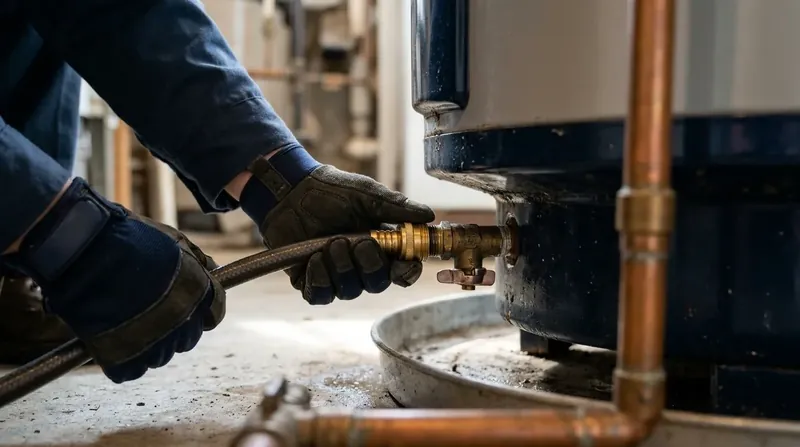
Drain and flush. This is the standard fix. A. O. Smith's steps: turn off the gas or power, run a hot faucet until the water is cool, connect a hose to the drain valve, shut the cold supply, open the drain valve and a hot faucet. If a lot of sediment comes out, open the cold supply with the drain still open and let water run through until no more sediment drains. Our full walkthrough is in how to flush a water heater.
If it won't drain. A. O. Smith says sediment can form large masses that keep the tank from draining, and that a qualified person can use a de-liming agent suitable for drinking water to remove them.
Electric elements. In very hard water, A. O. Smith says to remove and check the elements whenever you drain the tank, and that it's usually easier and cheaper to replace lime-encrusted elements than to clean off heavy deposits.
Tankless units don't collect sediment the same way but do scale up inside; they're descaled with a pump and solution instead (see how to flush a tankless water heater).
How often to flush
A. O. Smith recommends draining and flushing after the first six months of operation to see how much sediment builds up. If there's little, flush once a year; if there's a lot, flush more often. Bradford White passes on AHRI's suggestion to flush the tank each time you check the relief valve. The Department of Energy's Energy Saver Guide suggests draining a quart of water from the tank every three months to remove sediment.
Hard water makes it worse
The harder the water, the faster sediment builds. Some of the towns we serve have very hard water. Xenia, Ohio's water report says the city doesn't soften its water and calls it very hard, at close to 400 mg/L (23 grains per gallon). Canton also calls its well water very hard. A. O. Smith's advice to flush more often with hard water applies here.
A water softener reduces scale, but A. O. Smith notes the anode rod will deplete faster with softened water, so inspect it more often (see water softeners and water heaters).
Is sediment harmful?
The sediment in a tank is mostly what was already in your water, concentrated in one place. The bigger concern is usually for the heater. If you want to know what's in your water, your utility's annual Consumer Confidence Report lists what it tests for and finds; the EPA explains how to find yours. On a private well, test the water directly.
Rather have a plumber look at it?
Call and describe what's happening. We'll get a plumber out to diagnose and fix it.
Call for service(858) 465-8561Local pages mentioned
Related water heater services
Water Heater Repair
Gas, electric and tankless repairs, from pilot lights to heating elements.
Learn more
Water Heater Replacement
When repair no longer makes sense, get a new tank or tankless unit.
Learn more
Tankless Water Heater Repair
Error codes, lukewarm water and scale buildup on tankless units.
Learn moreCommon questions
How do I get rid of sediment in my water heater?
Drain and flush the tank through the drain valve, then run cold water through it until it comes out clear. If sediment has hardened into masses that block draining, A. O. Smith says a qualified person can use a de-liming agent safe for drinking water.
What are the symptoms of sediment in a hot water heater?
Popping or rumbling while heating, slower recovery, less hot water than before, and grit in faucet aerators. Electric tanks may also crackle or hiss from scale on the elements.
How often should sediment be removed from a water heater?
A. O. Smith says flush after the first six months, then at least yearly, more often if a lot of sediment comes out or the water is hard.
Is sediment in a water heater bad for you?
It's mostly minerals and particles that were already in the water supply. To see what your water contains, check your utility's annual Consumer Confidence Report, or test a private well.
What does water heater sediment look like?
Mineral grit and flakes, or sand and clay where it comes from a well or a main break. White plastic-looking bits can be a failing dip tube instead.
Sources
- A. O. Smith, Residential Standard Gas Water Heater Use and Care Guide (100277333, Oct. 2016)
- A. O. Smith, Residential Electric Water Heater Installation Instructions and Use & Care Guide (100277323)
- A. O. Smith, Is Your Hot Water Not Getting Hot? Common Causes & What To Do
- Bradford White, Service Manual: Residential and Light Duty Commercial Electric Water Heaters (238-54711-00A, rev. 5/22)
- Bradford White, Draining a Water Heater
- U.S. Department of Energy, Energy Saver Guide (2022)
- Moen, Faucet Aerator Cleaning
- U.S. EPA, Consumer Confidence Reports (CCR)
General information only. Gas, electrical and pressure work can be dangerous; when in doubt, call a licensed professional.
Still stuck? Get a plumber out.
Call now for water heater repair or replacement.